tiling
How Many Floor Tiles for a Room in India? Count the Boxes
Tiling a room at home? Measure its floor, allow for cuts and use the chosen tile's carton details to work out how many boxes to order.
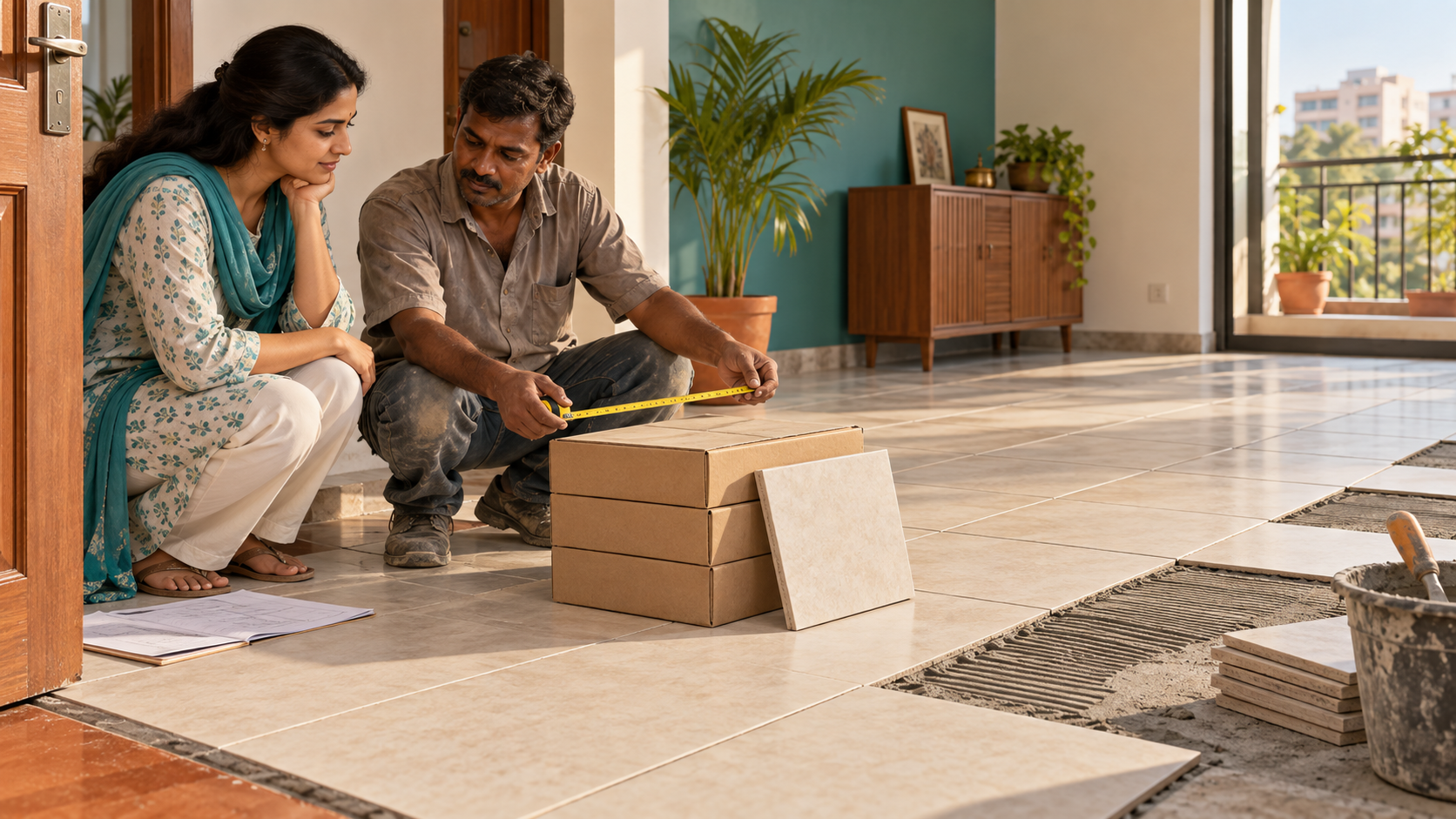
At a glance
A 12 × 8 ft bedroom has 96 sq ft of floor. If the tile you choose is 2 × 2 ft, an ideal uncut grid would take 24 pieces. With an illustrative 10% allowance for cuts, the order becomes 27 tiles. When that tile comes four to a box, you buy seven whole boxes. That is the answer to take to the dealer for this example, provided the room and carton really match these assumptions.
The order often goes wrong between the first measurement and the counter. The tiler needs to know the room's shape and where the pattern starts; the dealer needs a box count; you need to know what the installation quote includes. A single “96 sq ft” note cannot settle all three conversations.
Measure the finished floor, not just the drawing
Walk the bedroom with the tiler and measure between the finished wall lines. A plan drawn before plaster or a new partition may not match the space being tiled. In our simple rectangle, 12 × 8 = 96 sq ft. Keep both lengths beside that total so the tiler can lay out the tile rows.
Check the doorway while you are there. Will the bedroom tile continue under the shutter, stop at a threshold or meet a different passage tile? A wardrobe recess or an L-shaped corner can be measured as another rectangle and added. Mark those edges on the sketch before the dealer turns your area into cartons.
See why the first tile count is not the order
A 2 × 2 ft tile covers 4 sq ft, so 96 ÷ 4 = 24 tiles on area alone. The plan below shows six pieces along the 12 ft wall and four along the 8 ft wall. It is a useful way to picture the room, but it assumes straight walls, a convenient starting line and no lost cuts.
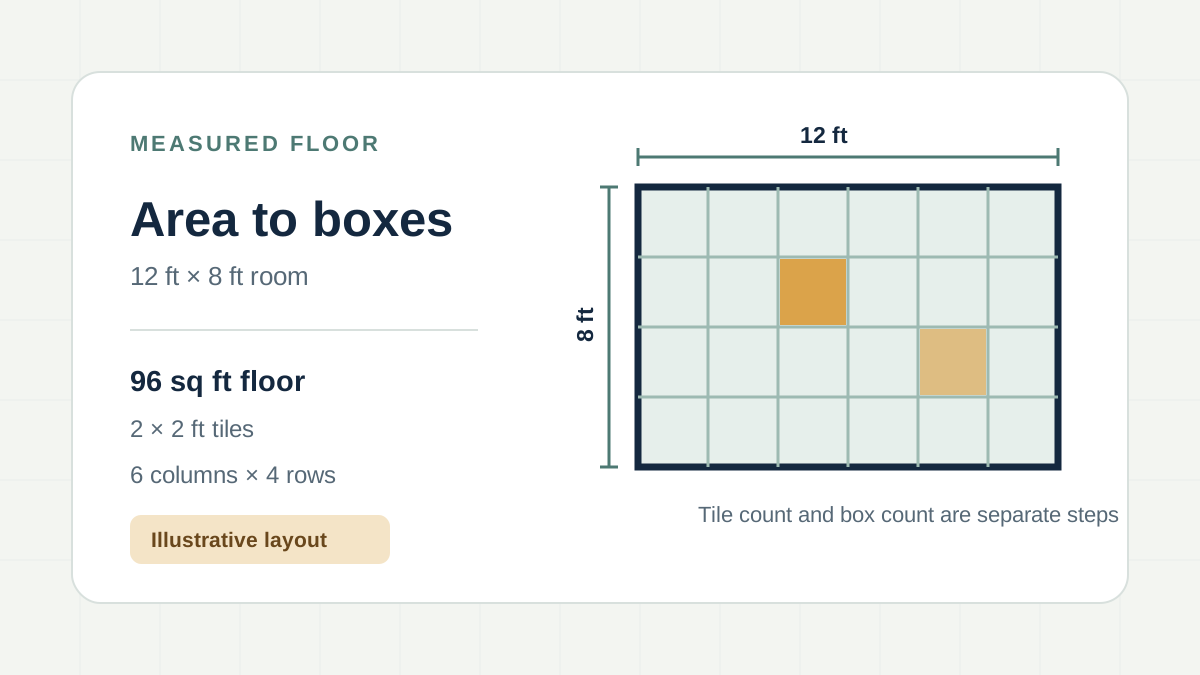
The tiler may centre the pattern so there is no narrow strip by the bedroom door. A wall may be slightly out of square. Some cut pieces may be reused on the opposite side, while others will be too short or in the wrong direction. Talk through the setting-out before adding an allowance; the percentage should reflect the job, not replace that conversation.
For our worked order, use 10%. The allowed area is 96 × 1.10 = 105.6 sq ft, equal to 26.4 of the chosen tiles. Round up to 27 whole pieces. If the carton contains four, 27 ÷ 4 = 6.75, so the dealer must supply seven boxes, or 28 tiles.
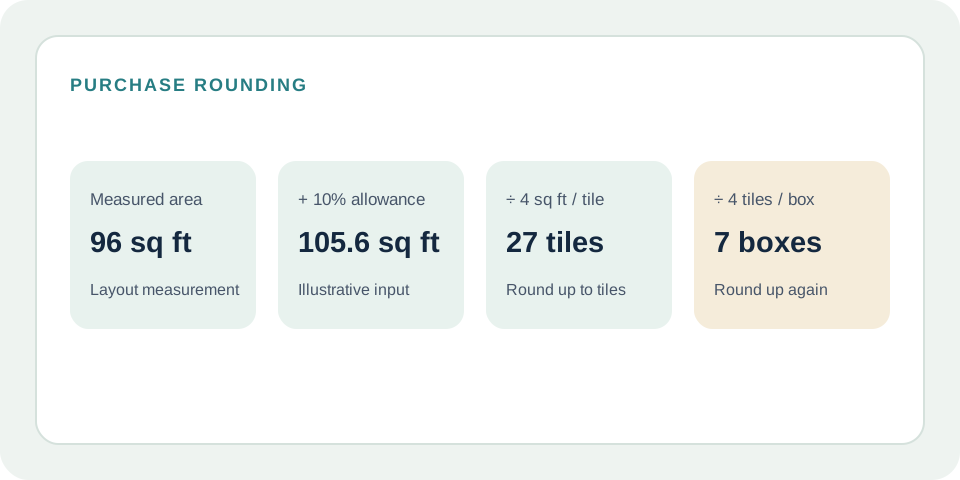
The twenty-eighth tile appears because you bought full boxes. It is separate from the cutting allowance already included in the 27-piece requirement. Before paying, look at the carton label: another tile may be a different size or have a different number of pieces in each box, even if the displayed sample looks similar.
Decide what happens along the walls
Floor skirting is often cut from the same tile in Indian homes. If that is the plan for this bedroom, the tiler needs the strip height and a cutting layout to say whether the seven boxes will cover both floor and skirting. The floor area alone cannot give a reliable strip count. If you are buying readymade skirting lengths instead, measure the run along the wall base, leaving out door gaps; the skirting guide works through that measurement.
The condition of the old floor also affects the job even when the tile count stays 27. Ask whether removing old flooring, levelling the base, adhesive, grout, edge cuts and cleaning are in the tiler's price. A dealer's box price and a tiler's sq-ft labour quote cover different things. Put both on the same written estimate before comparing one tile choice with another.
Check the carton and the delivery note
If the chosen tile is replaced because it is out of stock, the room remains 96 sq ft, but the area per piece and pieces per carton may both change. Recalculate from the replacement label rather than carrying forward “seven boxes”. Check finish and shade or batch as well, especially if the bedroom connects visibly to another tiled space. Confirm how the shop handles breakage, replacements and unopened cartons.
The seven boxes in this example are 28 pieces delivered for 27 pieces calculated. That one spare on paper may be cut during fitting. If you want unused tiles kept for a later repair, decide that separately with the tiler and dealer. The Floor Tile Calculator can apply the actual tile, carton and quoted rate to the same measured room.
If the cuts need a different allowance
A simple straight layout and a diagonal or patterned layout may need different purchase allowances. On this 96 sq ft floor with 2 × 2 ft tiles and four per box, a 5% allowance gives 26 tiles and still seven boxes. At 15%, it gives 28 tiles, again seven boxes. At 20%, it rises to 29 tiles and eight boxes. The move from seven to eight cartons is a real cost step, so choose the allowance with the installer from the planned cuts.
For a different room, start over with its measured floor. A 12 × 10 ft room would have 120 sq ft; with the same tile and example 10% allowance, it needs 33 pieces, or nine four-piece boxes. You can reuse the method, but neither the bedroom's 96 sq ft nor its seven-box order should travel to another room without measuring it.