construction
Septic Tank and Complete Septic System Installation Cost in India
Separate the septic tank price from the complete installation: excavation, construction, connections, effluent treatment, access and a worked cost example.

At a glance
In this guide8 sections
The tank has been built, its cover is in place, and the yard almost looks normal again. Then someone asks where the water leaving the tank will go. It is a question that belongs at the beginning of the project, even though the tank itself tends to dominate the quotation.
A septic tank price is not necessarily the price of a complete septic installation. The complete scope may include site assessment, approvals, excavation, the tank, inlet and outlet connections, an appropriate downstream treatment or dispersal arrangement, access, testing and reinstatement. What is suitable depends on the site and local requirements.
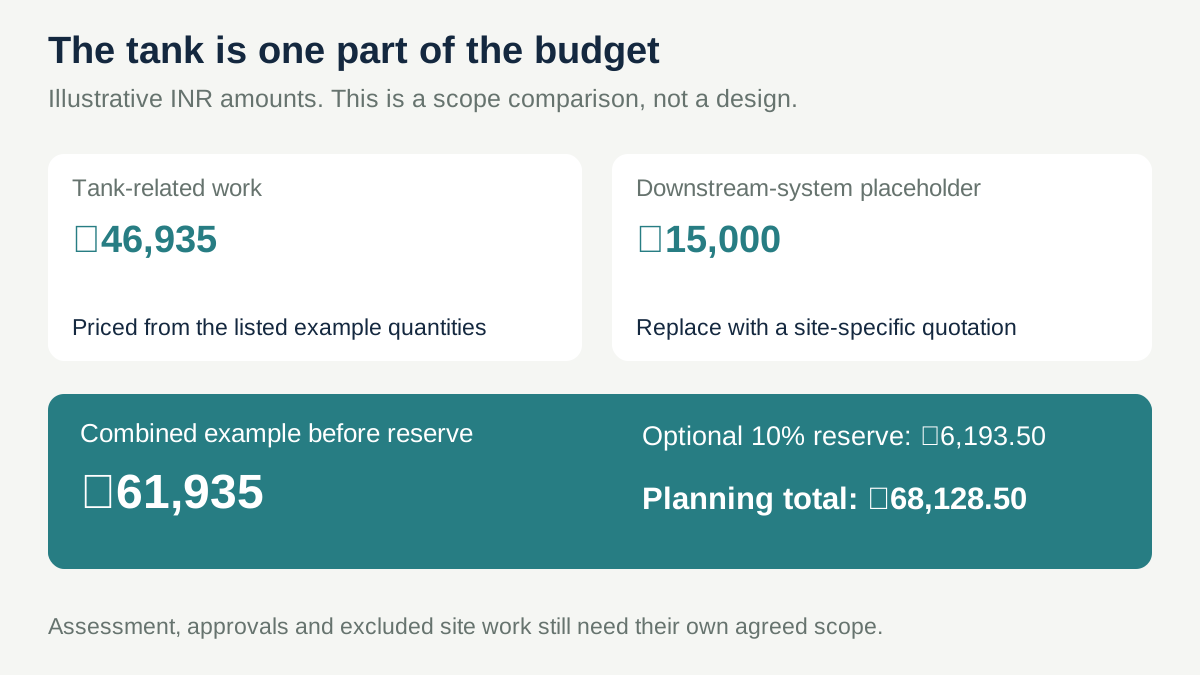
In our illustrative Indian example, the tank-related work totals ₹46,935. Adding an explicitly provisional ₹15,000 downstream-system allowance gives ₹61,935; a 10% planning reserve takes that to ₹68,128.50. These are example inputs, not verified market rates, a complete quotation or a recommended system for a particular household. The provisional allowance must be replaced by the designed and priced site solution before committing to the work.
Think about the whole route from the house
A septic tank provides an initial treatment stage. It does not turn every discharge into water that can be released anywhere. The US EPA's explanation of septic systems describes the distinction between settling in a tank and further treatment in an appropriate downstream arrangement. That explanation is useful background; it does not replace Indian local approval or site-specific design.
On a drawing, trace the route from the household drain to the tank and onward to the approved destination. Mark access points and the route a service vehicle can use. This exercise often reveals items missing from a short “septic tank construction” quote: a long connecting drain, difficult excavation access, a separate chamber or restoration of paving.
There may also be an available sewer connection or another locally approved sanitation option. Establish which system the site is allowed and suited to use before buying a tank. The cheapest tank is not a saving if the property cannot support the proposed installation around it.
Why the number of users is only the beginning
A contractor may ask how many people live in the house. That is relevant, but it is not a complete design brief. The designer also needs to know what wastewater reaches the system, expected use, occupancy changes, desludging arrangements and site conditions.
Soil, groundwater, flood risk, nearby water sources and available space can affect the viable solution. The EPA's information on septic systems and drinking water explains how groundwater movement and nearby wells can matter. Exact setbacks and other requirements must come from the applicable local authority and the responsible professional; this guide does not supply universal distances.
Be especially careful with a small tank dimension copied from a general table. A reference intended for toilet discharge under stated assumptions is not automatically suitable for all wastewater from the house. Ask the designer to identify the design basis, then use the resulting quantities for the estimate.
A tank budget, line by line
The following schedule uses assumed quantities from an imaginary completed design. It demonstrates pricing only. The concrete volume, reinforcement weight and masonry quantity are not recommendations for tank size, wall thickness or reinforcement.
| Tank-related item | Example quantity and rate | Amount |
|---|---|---|
| Excavation | 5 m³ × ₹550 | ₹2,750 |
| Bricks | 840 × ₹9 | ₹7,560 |
| Masonry mortar, plaster and coating materials | Defined allowance | ₹5,000 |
| Concrete material supply | 0.9 m³ × ₹7,500 | ₹6,750 |
| Reinforcement material | 75 kg × ₹65 | ₹4,875 |
| Formwork | Allowance | ₹2,500 |
| Masonry and plaster labour | Allowance | ₹6,500 |
| Small pipe fittings and covers | Allowance | ₹4,000 |
| Concrete placing and reinforcement labour | Allowance | ₹3,000 |
| Transport | Allowance | ₹2,500 |
| Specified leak testing | Allowance | ₹1,500 |
| Tank-related subtotal | — | ₹46,935 |
The rates are illustrative. A local quotation may bundle some of these items, but the scope should still be identifiable. If concrete supply already includes a service that has been priced again under labour, remove the duplication. If it excludes pumping or difficult handling, add those items where required.
Excavation is an especially site-sensitive line. Soil that can be excavated and reused on an accessible plot is different from rock, groundwater, unstable ground or a confined location. Shoring, dewatering, disposal and safe access need professional assessment and explicit pricing where applicable. The example rate does not promise to cover them.
A useful material check: brickwork quantity
Even without designing the tank, a homeowner can understand where a material estimate comes from. Suppose the approved quantity sheet contains 1.6 m³ of brick masonry. For this arithmetic example, assume a brick-and-joint module of 0.002 m³:
1.6 ÷ 0.002 = 800 theoretical bricks
With an assumed 5% purchasing allowance, that becomes 840 bricks, matching the example cost table. The module and allowance must reflect the actual brick size, joints and purchasing conditions.
If the brick itself measures 190 × 90 × 90 mm, its solid volume is 0.001539 m³. Using the 800 installed theoretical bricks, the simplified wet mortar estimate is:
1.6 − (800 × 0.001539) = 0.3688 m³
The 40 extra purchased bricks do not all become installed brick volume. This is why using 840 in that subtraction would distort the mortar estimate.
If the project specification calls for a 1:6 cement-to-sand mix by volume, an assumed dry-volume factor of 1.33, cement bulk density of 1,440 kg/m³, 50 kg bags and 5% material allowance give approximately 2.12 bags of cement and 0.44 m³ of sand for this masonry mortar calculation. Buying whole bags would mean three bags. These are estimating assumptions, not a mortar specification for every tank.
Plaster, coatings, concrete and other work remain separate. The mortar calculator can help check the quantity using the specified inputs, but it cannot determine whether the tank construction is suitable or watertight.
Add the part of the system beyond the tank
For arithmetic continuity, put a ₹15,000 provisional amount beside the downstream treatment or dispersal work. It is only a placeholder to show how the budget should be assembled:
₹46,935 + ₹15,000 = ₹61,935 before reserve
10% reserve = ₹6,193.50
Planning total = ₹68,128.50
Do not treat that ₹15,000 as a reliable soak-pit price or assume a soak pit is suitable. The downstream design may be different, may cost much more, or may not be feasible in the proposed location. Replace the placeholder with an assessed scope and quotation. The EPA's overview of system types illustrates why different sites can need different arrangements; local standards and the responsible designer govern the actual choice.
The example also leaves site-assessment fees, approvals, long external drain runs, pumps, power supply, major disposal, difficult access, substantial reinstatement and taxes outside the priced subtotal. A “complete” contractor quote should either include each applicable item or name it as an exclusion. The word complete should describe the scope, not conceal its boundaries.
Masonry, concrete or a prefabricated tank?
Comparing only the purchase price can be misleading. A prefabricated tank still needs a suitable installation, handling, excavation, connections and any specified support or restraint. A site-built tank needs its structural details, workmanship, watertightness and testing addressed. Neither option eliminates the need for a suitable system around it.
Ask each supplier or contractor to quote against the same required capacity, design basis and site information. Confirm delivery access and lifting arrangements where relevant. Obtain product specifications for a manufactured tank and approved construction details for a site-built one. The useful comparison is the installed, accepted system with its responsibilities clearly assigned.
Leave room in the plan for maintenance
Once the yard is finished, covers and access routes can disappear under landscaping or storage. Plan for inspection and desludging access before that happens. Ask who will service the system, what equipment they need and what the operating and maintenance instructions require.
Never enter a septic tank to inspect or clean it. Toxic gases and oxygen deficiency can make entry fatal; inspection, pumping and any confined-space work belong to suitably trained and equipped professionals. The South Carolina Department of Environmental Services' safety guidance also warns against leaning over an open tank. A homeowner's useful role is to keep the records, preserve access and arrange the prescribed service, not climb inside to investigate a problem.
At handover, collect the as-built location, design and product details, testing record, contractor contacts and maintenance instructions. Record the actual installed scope beside the final cost so a later repair or extension begins with reliable information.
Keep the house plumbing and outside system connected in the budget
The 1,000 sq ft plumbing cost guide covers the household side of the work. Establish exactly where that contractor's responsibility ends and the septic installer’s begins. A boundary at a named inspection chamber or connection is easier to verify than “outside plumbing extra.”
For this tank example in Hindi, read the septic tank construction cost guide. Use the excavation calculator and concrete quantity calculator only after the relevant dimensions and specifications are known.
The strongest budget is the one that follows the wastewater all the way through its intended system and follows the maintenance team all the way back to the access point. When both routes are clear, the tank price becomes one understandable part of a much better planned job.