Plumbing Cost for a 1000 Sq Ft House: Pipes, Points and Fixtures
Understand a 1000 sq ft house plumbing quote with a two-bathroom example, defined plumbing points, pipe quantities, labour, testing and fixture costs.
plumbing
At a glance
In this guide8 sections
Two houses can both measure 1,000 sq ft and need very different plumbing. In one, the kitchen and bathroom share a wall. In the other, two bathrooms sit at opposite ends of the plan, the kitchen is between them and the washing machine belongs on a distant balcony. The floor area is identical. The pipe routes are not.
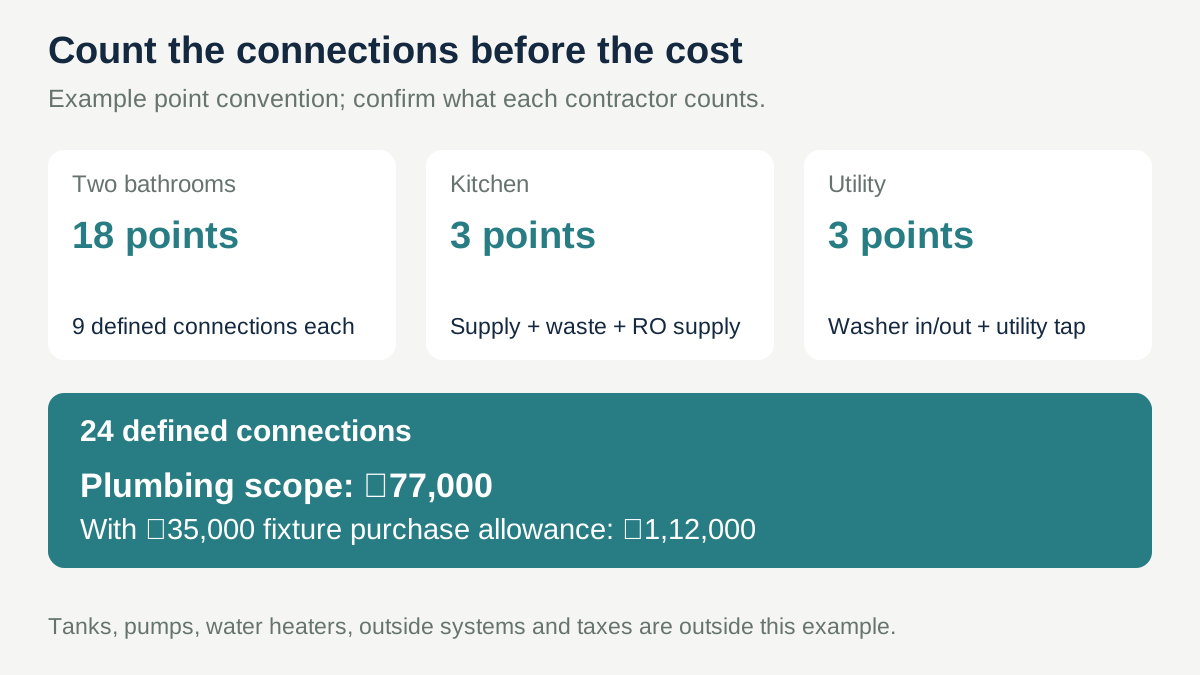
For a 1,000 sq ft house with two bathrooms, a kitchen and a utility area, the worked example in this guide totals ₹77,000 for the defined plumbing work, excluding fixture purchases. Add an illustrative ₹35,000 for taps, basins, toilets and shower fittings, and the example reaches ₹1,12,000. All prices are assumed Indian rupee inputs, not verified current market rates.
That is equivalent to ₹77/sq ft before fixtures or ₹112/sq ft with the stated fixture allowance. Those figures are results of this particular scope. Multiplying another house's area by them would skip the very decisions that produced the budget.
Begin with the places water is needed
Spread out the room plan and mark the kitchen sink, basins, showers, toilets, washing machine and utility taps. Identify which fittings need hot water, which need cold water and where each drain goes. Then trace their connections to the main supply and the household drainage outlet.
This is where a practical plumbing conversation starts. A short route behind a shared wet wall may differ considerably from a route crossing several rooms. A change in fixture position after plastering can involve opening and repairing surfaces as well as altering pipes.
Keep the tank, pump, water heater and outside drainage in view even if another contractor is handling them. Their interface with the indoor work needs to be agreed. “Plumbing complete” is much easier to understand when the drawing marks the start and end of the quoted scope.
What exactly is one plumbing point?
There is no useful universal answer without the contractor's definition. One installer may call a washbasin a point and include its connections. Another may count hot supply, cold supply and waste separately. A low rate multiplied by a large count can cost more than a higher rate using a different count.
For this guide, a point means one listed supply or drainage connection. The two bathrooms are assumed to have the same schedule:
| Connection in each bathroom | Points in this example |
|---|---|
| Shower hot and cold supply | 2 |
| Basin hot and cold supply | 2 |
| Toilet cistern supply | 1 |
| Health faucet supply | 1 |
| Floor drain | 1 |
| Basin waste connection | 1 |
| Toilet soil connection | 1 |
| Total per bathroom | 9 |
Two bathrooms give 18 points. The kitchen adds three: sink supply, sink waste and an RO supply connection. The utility adds three: washing-machine supply, washing-machine waste and a utility tap. Total: 24 defined connections.
This is an example counting convention, not a standard method for every quotation. It also does not mean every pipe branch, fitting or metre of drain is priced independently by this count. Ask the contractor what the per-point labour covers, especially shared mains, vertical stacks and long runs.
Supply pipes and drains do different jobs
The water arriving at a tap and the wastewater leaving a basin travel through different systems. They need appropriate products, sizes, joints, supports and installation details. Describing both simply as “plastic pipe” hides information that matters to the quote.
For example, Astral's CPVC plumbing range describes hot- and cold-water applications, while its drainage range addresses a different service. These are examples of manufacturer product categories, not instructions to choose one brand or use the same pipe size throughout the house.
The plumber or designer should establish the suitable system and sizes for the installation. Your estimate should then list the specified products, approximate route lengths and included fittings. Different diameters should ideally be separate lines. An average rate can help explain a preliminary example, but it is less precise than a diameter-by-diameter quotation.
Build the material allowance from visible quantities
Our imaginary layout has 85 m of supply pipe and 45 m of drainage pipe, counted across the relevant runs. The average rates below are simplifying assumptions for the example, not product quotations.
| Material group | Example basis | Amount |
|---|---|---|
| Supply pipe | 85 m × assumed average ₹180/m | ₹15,300 |
| Drainage pipe | 45 m × assumed average ₹300/m | ₹13,500 |
| Fittings, valves and traps | Itemised-scope allowance | ₹11,500 |
| Fixture connection accessories | Allowance | ₹5,500 |
| Jointing materials and supports | Allowance | ₹3,500 |
| Material subtotal | — | ₹49,300 |
The accessories line covers connection components in this example, not the purchase of the basins, toilets or tap sets themselves. Keep that distinction written on the quotation. Otherwise the same word, “fittings,” may mean pipe elbows to one person and bathroom tapware to another.
Fittings can also make a route more expensive than its pipe length suggests. A short but congested connection may contain several changes of direction, valves and adaptations. That is why a pipe-only multiplication rarely represents the whole material bill.
Add labour, making good and testing
For this example, assume ₹700 of labour per defined point. Then identify the other operations that this particular per-point allowance does not include:
| Work | Example basis | Amount |
|---|---|---|
| Connection labour | 24 × ₹700 | ₹16,800 |
| Chasing and agreed making good | Separate allowance | ₹6,500 |
| Specified testing and checks | Separate allowance | ₹2,500 |
| Transport and handling | Separate allowance | ₹1,900 |
| Labour and associated work | — | ₹27,700 |
| Materials plus work | ₹49,300 + ₹27,700 | ₹77,000 |
If your contractor includes chasing or testing in the point rate, do not add them again. Conversely, confirm whether “making good” means a basic repair ready for the next trade or a completely finished and painted wall. In a renovation, matching existing tiles can become a separate cost and availability problem.
The testing procedure, test conditions and acceptance criteria should follow the specified system and responsible professional's requirements. Agree to inspect and test the relevant work before it is concealed. A neat plaster surface tells you very little about a hidden joint.
Now choose the things you can see
The concealed plumbing can remain much the same while the fixture bill changes considerably. Tapware, toilets, basins, shower fittings and accessories have their own product choices, installation needs and prices.
Add an illustrative ₹35,000 fixture purchase allowance to the ₹77,000 scope and the total becomes ₹1,12,000. The allowance is not a guarantee that a chosen fixture collection will fit it. Make a product list with quantities and quotations before ordering. Confirm compatibility with the planned connections and site conditions.
The ₹77,000 base subtotal divided by 24 is approximately ₹3,208 per defined point, but that includes materials and shared work. It must not be confused with the ₹700 labour rate used in one line. Likewise, ₹112/sq ft is the full example spread over the house area, not a fixture price or a labour price.
Tanks, pumps, water heaters, septic systems, external mains, rainwater systems, waterproofing, major structural repairs and taxes are excluded from these totals. If any are part of your project, give them separate quoted lines. For the outside sanitation scope, see the complete septic installation cost guide.
What if you are doing only one bathroom?
A smaller job can still carry shared setup and testing costs. As an isolated arithmetic example, suppose one bathroom needs ₹12,000 of materials, nine defined points at ₹700 labour, and ₹3,000 for agreed repair and testing work:
₹12,000 + ₹6,300 + ₹3,000 = ₹21,300
That example excludes fixture purchase and any shared main-pipe work. It should not be read as one half of the two-bathroom house estimate. The house example also contains a kitchen, utility, longer routes and shared material allowances. Dividing a complete-house total by the number of bathrooms loses those distinctions.
For a renovation, the bathroom renovation cost guide helps place plumbing alongside demolition, waterproofing, tiles and fittings. Those tasks often affect one another, especially when the layout changes.
Compare quotes while changes are still easy
Give each plumber the same marked plan and fixture schedule. Ask for the point definition, pipe systems and sizes, route assumptions, labour scope, test procedure and exclusions. If one quote is much lower, look first for a different scope or product specification instead of assuming an equivalent bargain.
Before closing the work, keep photographs of the routes and a record of valve locations. Confirm that shut-off points remain accessible and that service access has not been blocked by cabinetry. At handover, check operation with the responsible installer and retain the testing record, product details and invoice.
You can read this example in Hindi as well. In either language, the most useful estimate begins with the same ordinary question: where does the water need to go? Once the routes, connections and responsibilities are clear, the cost becomes much easier to explain.