painting
Wall Putty, Primer and Paint Sequence for Indian Homes
Repainting a room or finishing new plaster? Check the wall condition and product instructions, then estimate putty, primer and paint separately.
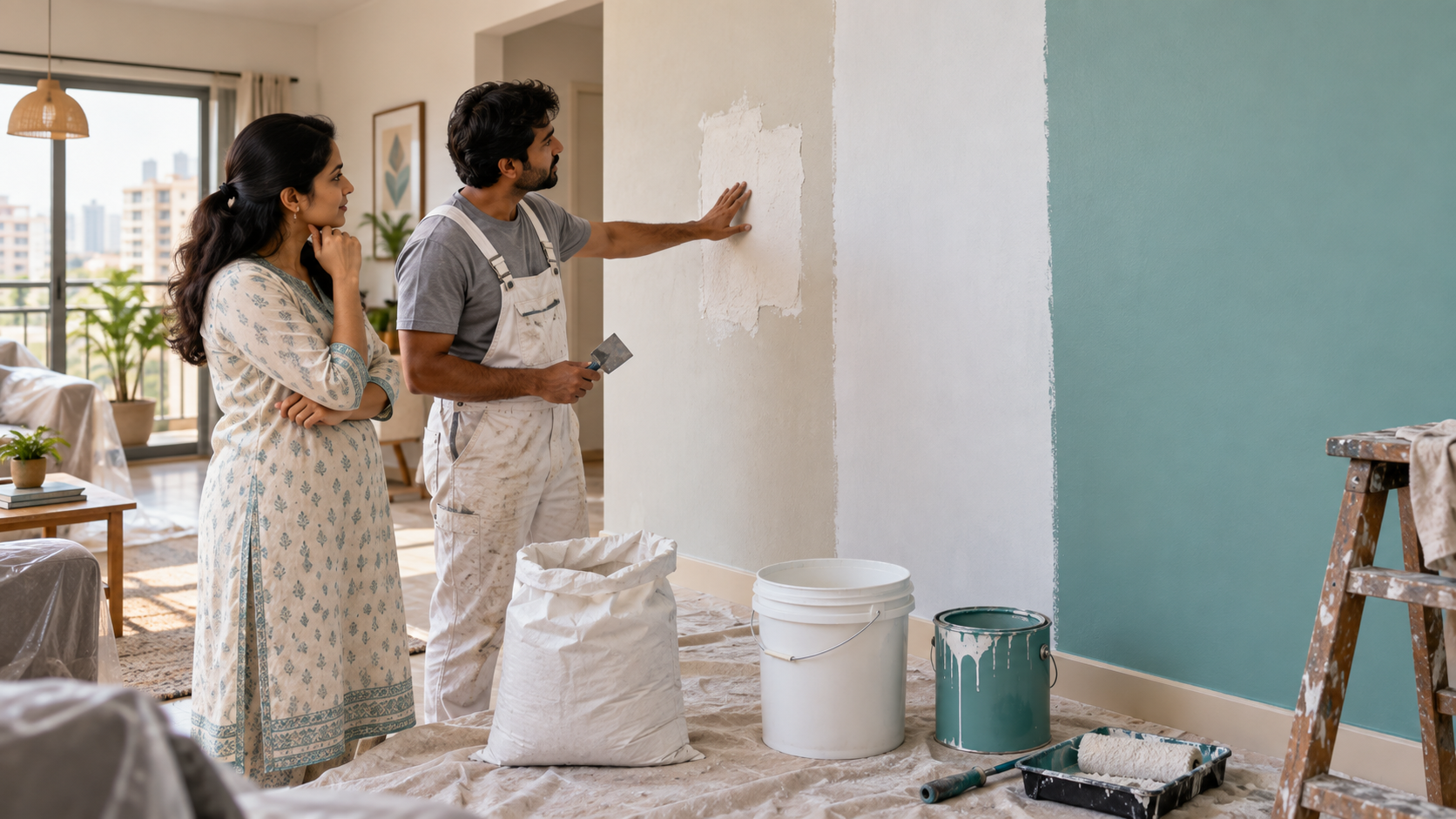
For a 12 × 10 ft bedroom with 10 ft high walls, one door and one window, there are 407 sq ft of flat wall face to consider. If a sound repaint needs putty only on 60 sq ft of damaged patches, the putty quantity can be very different from the primer and finish-paint quantities for the full walls. Under the illustrative coverages below, the job calls for about 4.4 kg of putty, 2.98 L of primer and 3.58 L of finish paint, before choosing packs.
Those figures are not a shopping list for every room of that size. They describe one agreed preparation plan. A newly plastered bedroom may need full-wall preparation, while an old wall with dampness needs the cause fixed before any coating. The painter's proposed products and their application instructions decide the sequence.
Look at the wall before accepting “putty, primer, paint”
A painter's quote can list those three words as though they always describe one standard job. Walk the bedroom together and look at what is already on the surface. Are the old coats sound? Is paint peeling near the window? Are there dents to fill, chalky patches to remove or a recurring crack that needs assessment? Full-wall putty is not automatic because a colour is changing.
If a patch is damp, deal with the moisture source first. Covering it with another coat does not solve the problem beneath. On fresh plaster, check when the surface will be ready for the chosen system. The ceiling may need another shade, and wood or metal frames may need other products, so decide whether they are included before counting wall materials.
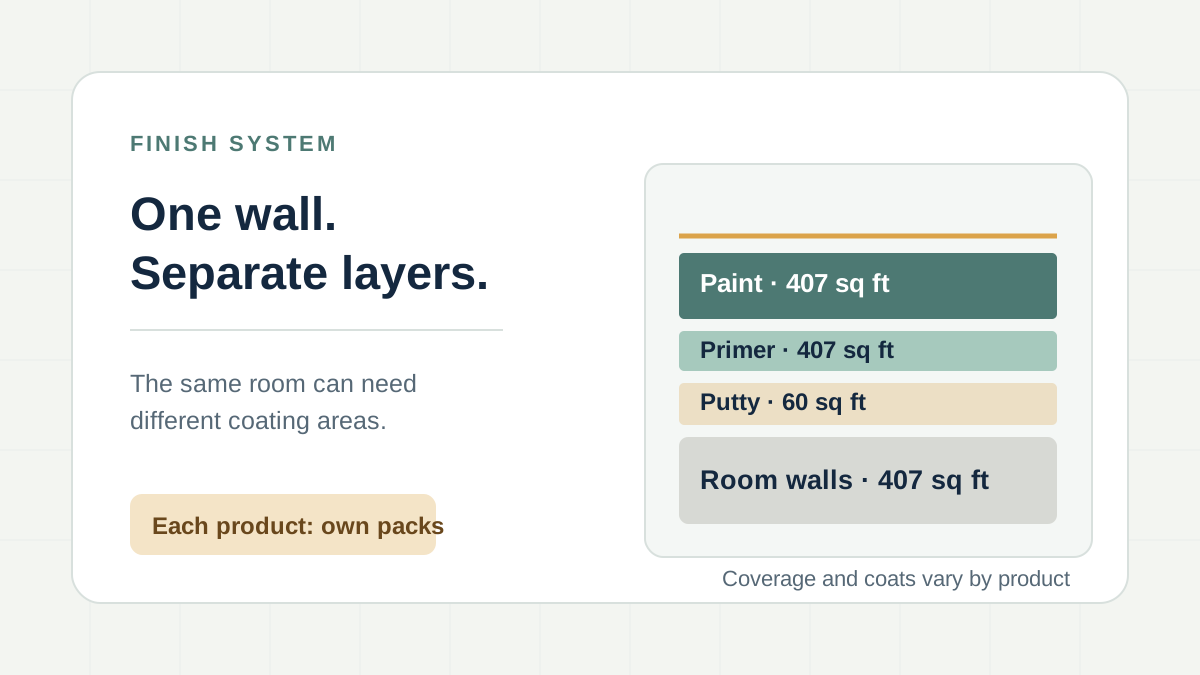
The same room can therefore produce different preparation bills without its dimensions changing. That is the first part of the estimate to settle with the painter.
Let the chosen products settle the order of coats
There is no single putty-and-primer order to apply to every brand and wall. The Asian Paints Professional Wall Putty product instructions show putty coats followed by primer and emulsion. The JSW Paints Profect Wall Primer instructions describe primer, putty where needed, another primer coat and then finish paint. Both describe their own specified systems.
Ask which exact putty, primer and paint the painter will use, then check those products' instructions for surface preparation, drying, dilution and coat counts. This is especially important when a painter substitutes a product after quoting. Changing one tin can change the method even if the bedroom still measures 12 × 10 ft.
Measure the walls once and give each layer its own area
The room's wall perimeter is 2 × (12 + 10) = 44 ft. At 10 ft high, the gross wall face is 440 sq ft. A 3 × 7 ft door removes 21 sq ft and a 4 × 3 ft window removes 12 sq ft, leaving 407 sq ft of flat wall. The ceiling is 120 sq ft, if it is part of the job.
For this repaint, the damaged patches together cover 60 sq ft. The chosen example system uses putty on those patches, one primer coat on all 407 sq ft of walls and two finish coats over the same wall face. Those are three areas of application, not extra room geometry. If the selected product system primes only repaired areas, change the primer line. If putty covers all walls, its line becomes 407 sq ft. Write those decisions next to the products on the quote.
| Material in this repaint example | Area to use | Agreed work |
|---|---|---|
| Putty | 60 sq ft | Repair patches |
| Primer | 407 sq ft | One full-wall coat in the selected example system |
| Finish paint | 407 sq ft | Two coats on the walls |
| Ceiling finish, if selected | 120 sq ft | Separate surface, perhaps another shade |
At the paint shop, calculate packs product by product
Use these illustrative coverages only to follow the arithmetic: putty 15 sq ft per kg for the stated application, primer 150 sq ft per litre per coat and finish paint 250 sq ft per litre per coat. Add an illustrative 10% handling allowance to each quantity. The patch putty is 60 ÷ 15 × 1.10 = 4.4 kg. One primer coat on 407 sq ft needs 407 ÷ 150 × 1.10 ≈ 2.98 L. Two finish coats need 407 × 2 ÷ 250 × 1.10 ≈ 3.58 L.
Now look at the packs actually sold for your chosen products. If the putty comes in a 5 kg pack, one covers this example patch requirement. If suitable 4 L packs are available for the primer and paint, one of each product would exceed its own calculated quantity. Do not add primer litres to paint litres and buy them as though they were interchangeable.
Read the coverage wording before multiplying by coats. Some labels state area per litre per coat; others state coverage for two coats together. Doubling the latter would overstate the amount you buy. Rough, porous or heavily patched walls can also change coverage, so the product sheet and painter's application plan take priority over these sample values. The 10×10 room painting cost guide works one finish-paint quantity through to a pack and an illustrative labour price.
Compare the painter's quote with the material list
Once the surfaces and products are known, ask for the labour scope in writing. Does it include scraping loose paint, filling the 60 sq ft of patches, sanding, furniture protection and cleaning? Are ceiling work and door frames separate? Two quotes both headed “painting” can cover different preparation and coat counts.
The material bill and labour quote may also use different units. A shop sells putty by pack and paint by tin, while a painter may charge for the room, the measured wall area or a bundle of preparation and painting work. Note the basis before comparing totals. If a damp patch is repaired separately, make that visible rather than hiding it inside the paint rate.
If the room is new, or the ceiling is included
On newly plastered walls, suppose the selected system calls for putty across all 407 sq ft. At the same illustrative coverage and allowance, putty rises from 4.4 kg for patches to 407 ÷ 15 × 1.10 ≈ 29.85 kg. That is a different job despite the identical room dimensions; ask about the actual pack sizes and product instructions before buying.
A 120 sq ft ceiling with two coats of the example finish paint would need 120 × 2 ÷ 250 × 1.10 ≈ 1.06 L. If it is white and the walls are another shade, its paint is a separate line and pack choice. Primer or putty on the ceiling needs its own decision as well.
Keep the room measurement for future estimates, but record each preparation plan and product choice separately. When the painter's quote names the surface, sequence, coats and material clearly, you can see why a repaint costs less or more than a fresh-plaster finish without blaming the difference on the room size.