painting
10×10 Room Painting Cost in India: How Much Paint and Labour Will You Need?
Work out the paint quantity and painting cost for a 10×10 ft room, from measuring the walls to choosing packs and comparing a painter's quote.
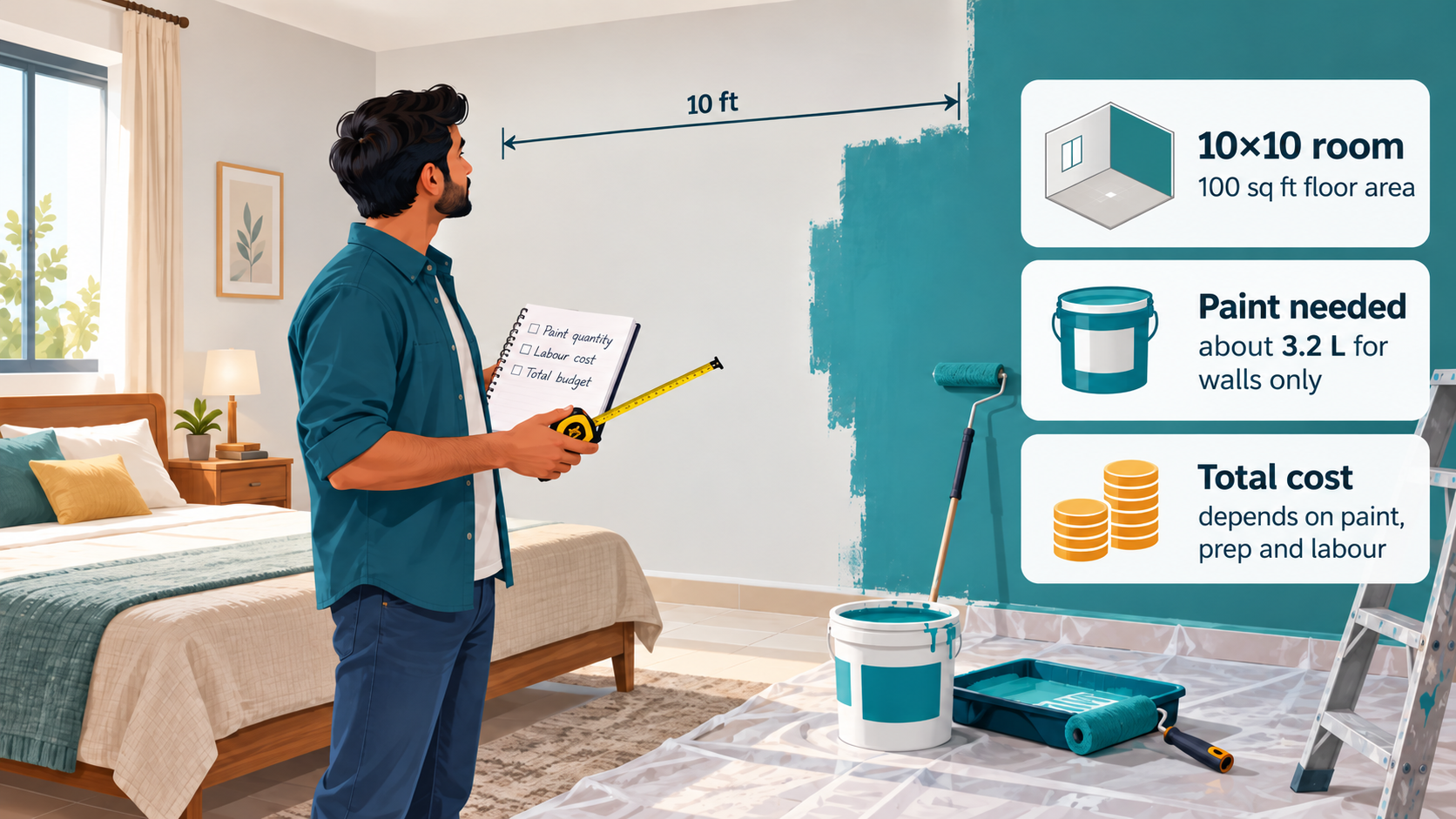
For a 10×10 ft room with 10 ft high walls, one door and one window, you can start by budgeting for about 3.23 litres of finish paint for the walls. That is a two-coat estimate using the coverage and allowance explained below, so a 4 L pack would be a sensible wall-only purchase if your chosen paint is sold in that size. The ceiling, primer and putty are separate.
The money side needs one more piece of information: what your painter is actually quoting to do. To make the numbers tangible, a 4 L paint pack priced at ₹953 and an assumed wall-painting labour quote of ₹4,500 would give a subtotal of ₹5,453. It is not an all-inclusive or standard price for a 10×10 room. Here is how to arrive at a figure that fits your room rather than someone else's estimate.
Start with the walls, not the room's floor area
Suppose you tell a painter that your bedroom is 10×10 ft. That gives them the floor area—100 sq ft—but it does not tell them how much wall there is to paint. A room with a 9 ft ceiling has less wall area than the same room with a 10 ft ceiling. Doors and windows make a difference too.
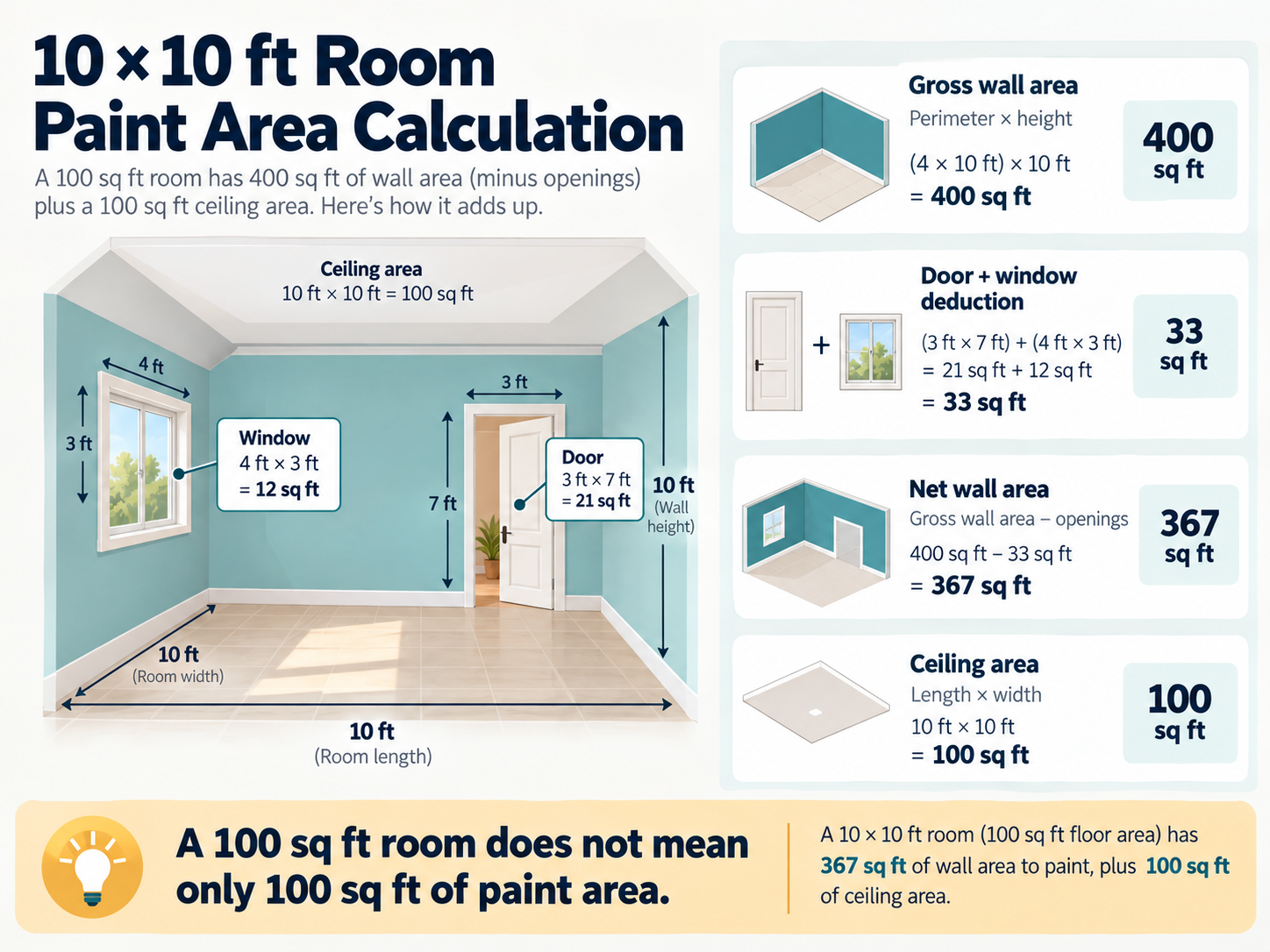
For our example, take four 10 ft long walls, each 10 ft high. Together they cover 400 sq ft: 2 × (10 + 10) × 10. Now subtract the parts you are not painting: a 3×7 ft door opening (21 sq ft) and a 4×3 ft window opening (12 sq ft). That leaves 367 sq ft of walls, or about 34.1 m².
This is a useful figure to take to the paint shop or share with your painter. Just check what has been excluded. The door shutter, wooden or metal frame, and the sides of a deep window opening may still need finishing, even though the main openings have been deducted from the wall area. They may also need a different product from the wall paint.
Turn 367 sq ft into litres of paint
You now know the area, but you still need to choose the paint. Coverage varies between products and with the surface beneath them. For this worked example, assume one litre covers 250 sq ft in one coat, and you want two finish coats.
The calculation is 367 × 2 ÷ 250 = 2.94 L (rounded). Add an illustrative 10% allowance for paint left on tools, small touch-ups and similar losses, and the figure becomes 3.23 L. This is the wall-paint requirement before rounding up to a pack size.
Do not copy the 250 sq ft figure blindly onto a different tin. For example, the Asian Paints Tractor Emulsion product information gives expected coverage of 250–270 sq ft/L for one coat and 130–150 sq ft/L for two coats together on a normal masonry surface after brushing. The second figure already accounts for two coats; multiplying it by two again would overstate your requirement. Check the coverage instructions for the product you choose, especially if your walls are rough, porous or heavily patched.
At the paint shop, decide whether the ceiling is part of the job
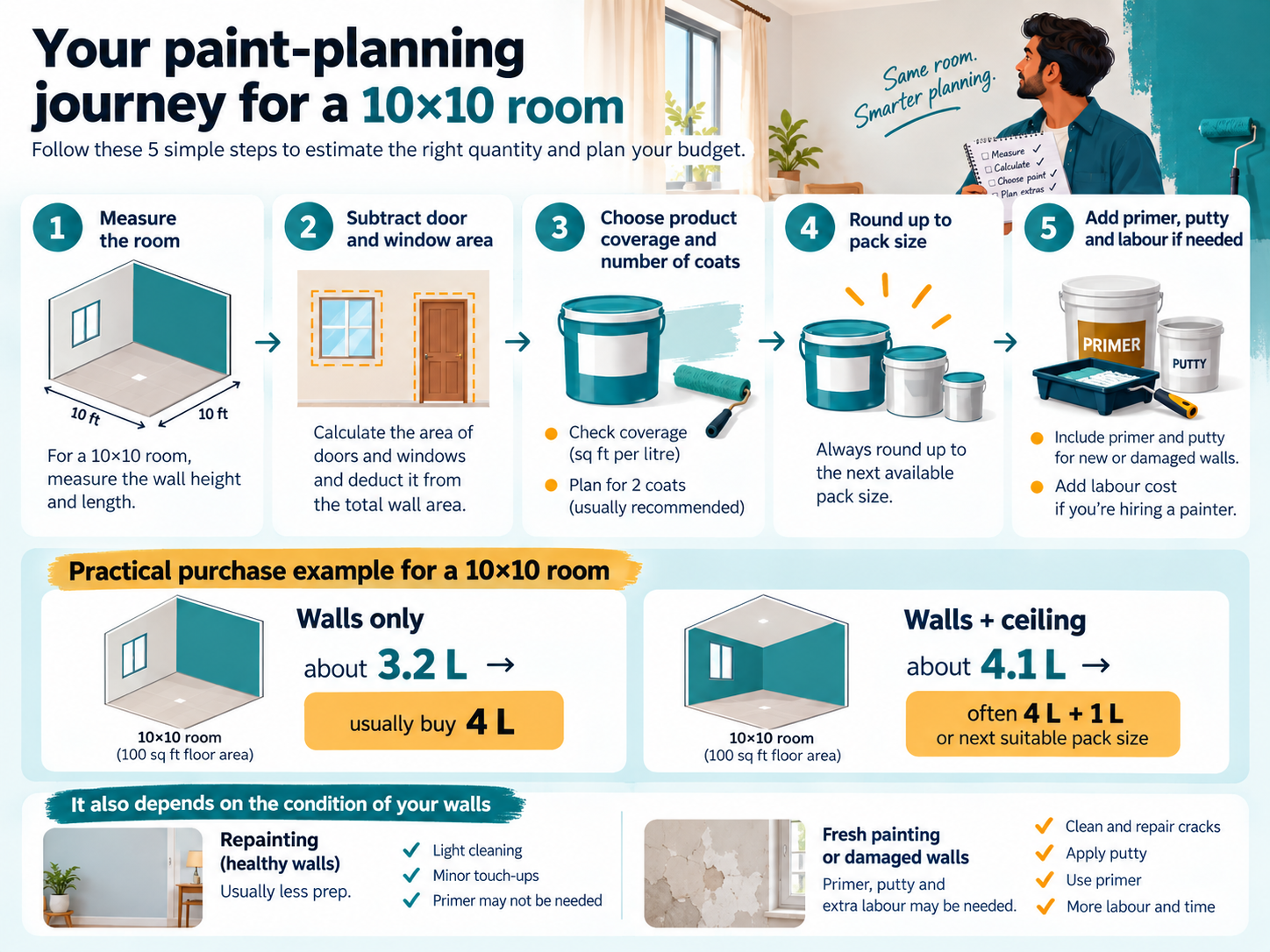
For the walls alone, three 1 L packs would not meet the calculated 3.23 L requirement. One 4 L pack or four 1 L packs would, provided the paint and shade are available in those sizes. A 10 L or 20 L pack is more than this room needs for its walls; it becomes relevant only if you are also painting other spaces in the same product and shade. Check the actual pack prices before deciding—buying the smallest number of tins is not always the cheapest option.
The ceiling is where an otherwise reasonable shopping list can go wrong. In a 10×10 ft room, it adds another 100 sq ft (about 9.3 m²). Under the same example assumptions, it needs 100 × 2 ÷ 250 × 1.10 = 0.88 L of paint. If both walls and ceiling use exactly the same paint and shade, the combined requirement is about 4.11 L. A 4 L pack would be slightly short, so a 4 L plus a 1 L pack is one possible combination.
In many rooms the ceiling is white while the walls are another shade. If that is your plan, work out and buy the ceiling paint separately. Do not assume you can use the wall-paint balance on the ceiling, or that primer and putty can be counted as part of the 3.23 L finish-paint figure. Water added for thinning is not additional paint bought in litres; follow the selected product's dilution instructions.
Before agreeing on a price, look at the condition of the walls
Imagine two 10×10 bedrooms in the same building. In one, the old paint is sound and the owner only wants a change of colour. In the other, paint is peeling near a window, a few cracks need attention and the surface has uneven patches. The measured wall area may be identical, but the preparation—and therefore the bill—will not be.
On a sound repainting job, ask the painter what cleaning, sanding and local filling are needed before the finish coats. Full-wall putty may not be necessary just because the room is being repainted. If paint is loose or chalky, it needs to be dealt with before a fresh coat goes on. If the patch is damp, find and fix the moisture source first; painting over it is not a lasting repair. Have a recurring or substantial crack assessed rather than simply covered with putty.
Newly plastered walls are a different job. The surface must be ready for coating, and the selected paint system may call for putty, primer and finish paint in a particular sequence. Ask for those materials and the associated labour to be quoted separately. Their quantities depend on their own product coverage and on where they are being applied—not on the 3.23 L finish-paint calculation. The guide to primer, putty and paint sequence explains what to check before work begins.
Finally, compare the painter's quote with the paint bill
Once the room area, paint and preparation are clear, the cost stops being a guess. As a specific price example, the Asian Paints Tractor Emulsion listing displayed an MRP of ₹953 for a 4 L pack when this draft was prepared. The final price can vary with shade, finish and the shop's quotation, so use the price you are actually offered.
Now suppose your painter quotes ₹4,500 as a fixed labour charge for painting the 367 sq ft of walls. This is an invented quote used to show the calculation, not a verified local labour rate:
| Wall-only example | Amount |
|---|---|
| One 4 L pack of finish paint, using the listed MRP | ₹953 |
| Assumed labour quote for wall painting | ₹4,500 |
| Paint and labour subtotal | ₹5,453 |
That subtotal does not pay for the ceiling, primer, putty, substantial repairs or other items unless the painter has expressly included them. A job covering fresh plaster will have a different cost from a straightforward repaint, even when both rooms measure 10×10 ft. This is why an unqualified “rate per sq ft” can be misleading: ask whether it is being applied to 100 sq ft of floor, 367 sq ft of net walls, 400 sq ft of gross walls or a lump sum for the room.
Before you approve the quotation, make sure it says which surfaces are included, the exact paint product and shade, the number of coats, what scraping or filling will be done, and whether primer, putty, furniture protection, cleaning and taxes are part of the price. Then you can compare two quotes for the same work, instead of finding out midway that one painter had left the ceiling or preparation out.
If your room is 10×12 ft or the ceiling is lower
You do not need a new estimating method for every bedroom size. Keep the same opening deductions, coverage, two coats and 10% example allowance, then change the dimensions. A 10×12 ft room with 10 ft high walls has 2 × (10 + 12) × 10 − 33 = 407 sq ft of net walls, requiring about 3.58 L. A 12×12 ft room under those same assumptions has 447 sq ft of net walls and needs about 3.93 L. Their ceilings would be 120 sq ft and 144 sq ft respectively, if you are painting them.
Even a small change in height matters. If our original 10×10 ft room has 9 ft walls, not 10 ft walls, its net wall area falls to 327 sq ft and its two-coat paint estimate to about 2.88 L, including the same allowance. Measure the actual room, check the selected paint's coverage and ask your painter to price the work you have decided to include. Those three details will tell you far more about your bill than the words “10×10 room” on their own.