painting
Putty, Primer and Paint: Plan Each Layer Separately
Inspect a room wall by wall, then calculate putty, primer and finish paint as separate materials with separate quote lines.
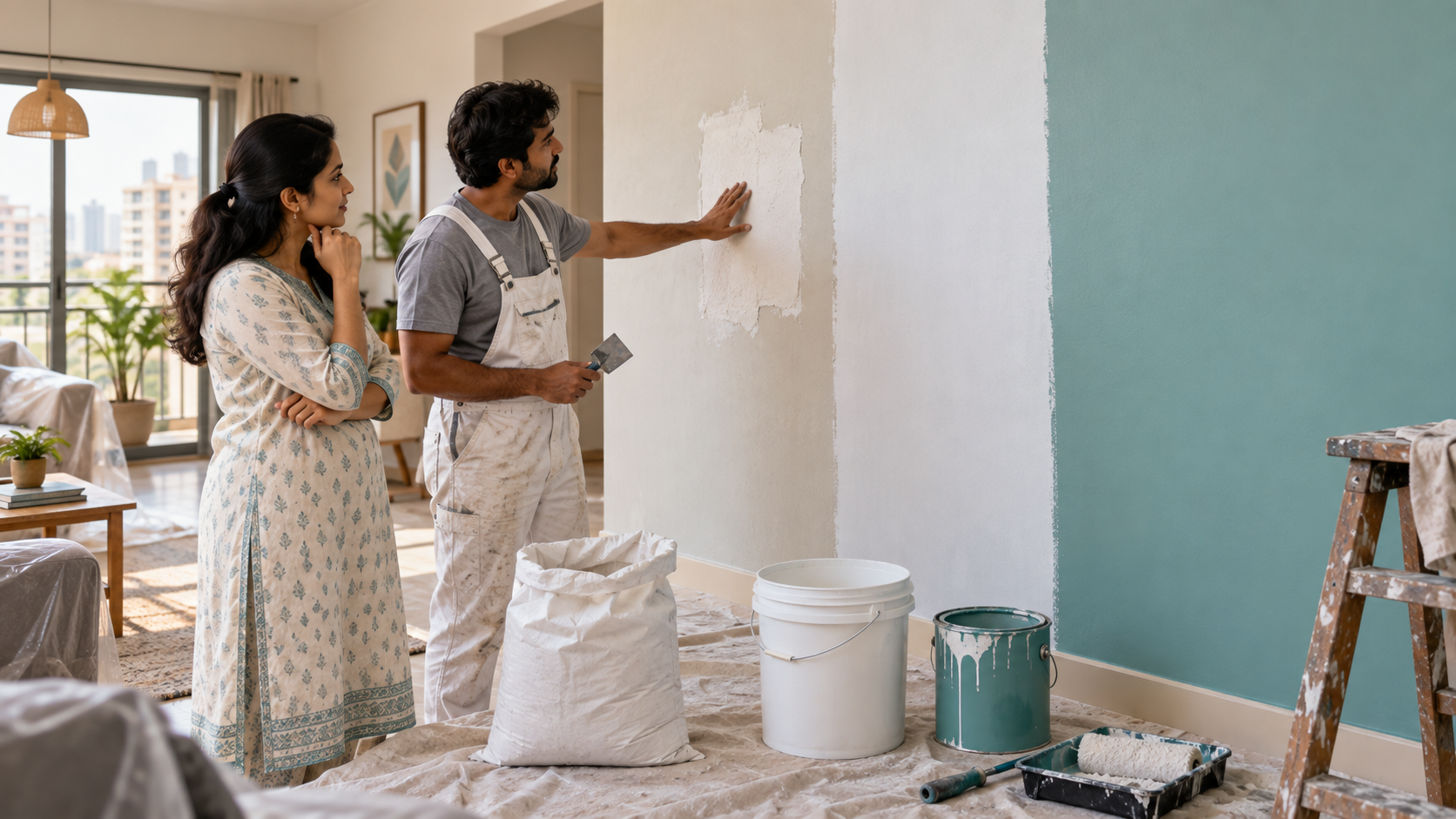
The painter walks into a room and says, “We will do putty, primer and two coats of paint.” At first it sounds like one job. At the shop it becomes different products, different pack sizes and possibly different areas. You can save yourself a confusing bill by asking what each layer is for before counting how much to buy.
Picture a 12×10 ft bedroom in an Indian flat. One wall has a few filled patches; the rest of the old paint is sound. Now picture the same room just after plastering, with a fresh surface that has not yet received a finish. The dimensions match, but the preparation should not be copied from one room to the other. Walk the surfaces with the painter first, then choose the coating system according to the actual wall condition and the selected products' instructions.
Start by asking what is on the wall today
On a sound repaint, look for loose or chalky old paint, stains, cracks and uneven patches. Ask the painter what cleaning, scraping, sanding and local filling are proposed. Full-wall putty is not automatic just because a colour is changing. If a patch is damp, identify and fix the moisture source before covering it. A recurring or substantial crack needs proper assessment rather than a quick cosmetic fill.
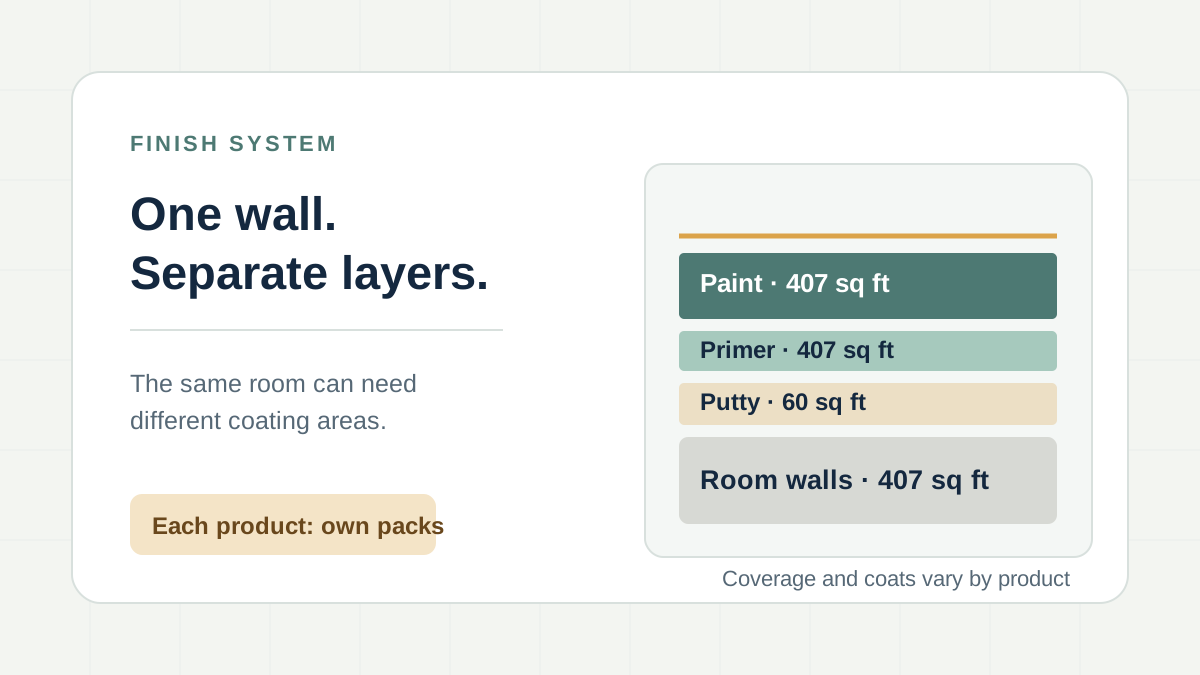
For a newly plastered wall, ask when the plaster will be ready for the chosen system and what sequence its manufacturer specifies. Some jobs call for full-surface preparation; others differ with the substrate and product. Do not treat the simple stack in the diagram as a universal instruction for every brand and wall. Confirm drying, application order, number of coats and dilution from the products you will actually use.
This inspection also fixes scope. Are you coating the four walls, the ceiling or only an accent wall? Is the ceiling a different shade? Are wooden or metal door frames part of the painter's quote? Write those down separately. A wall-paint litre calculation should not quietly include a door frame that needs another finish.
Measure the room once, then assign area to each layer
Our bedroom has 12 ft and 10 ft sides and 10 ft high walls. The gross wall area is 2 × (12 + 10) × 10 = 440 sq ft. Deduct a 3×7 ft door (21 sq ft) and a 4×3 ft window (12 sq ft). That leaves 407 sq ft of flat wall face. A 12×10 ft ceiling would add 120 sq ft, but only to the product lines that will actually cover it.
Now return to the repaint version of the room. Suppose only a few damaged patches, together measuring 60 sq ft, need putty. If the chosen system requires primer across all prepared walls, its area might be 407 sq ft. If the two finish coats cover all the walls, paint also starts from 407 sq ft. These are three separate applications on the same room, not 60 + 407 + 407 = 874 sq ft of new geometry.
| Product line in this repaint example | Area to record | Why it differs |
|---|---|---|
| Putty | 60 sq ft | Only the marked patches |
| Primer | 407 sq ft | Assumed full-wall treatment for the chosen system |
| Finish paint | 407 sq ft | Two coats on all selected walls |
| Ceiling finish, if included | 120 sq ft | Separate surface and possibly another shade |
The primer and putty choices above are example scope decisions. If the selected product instructions call for primer only on repaired patches, change its area accordingly. If fresh plaster needs full-wall putty, that area may become 407 sq ft. Keep the measured room the same and update the work choice.
At the counter, make three different calculations
Suppose the product information for this example gives these illustrative coverages: putty covers 15 sq ft per kg for the specified application, primer covers 150 sq ft per litre per coat, and finish paint covers 250 sq ft per litre per coat. The painter plans one primer coat and two finish coats. Add an illustrative 10% handling allowance to each calculated quantity. These figures are arithmetic inputs, not coverage promises for products you may buy.
- Putty for the 60 sq ft of patches:
60 ÷ 15 = 4 kg; with allowance, 4.4 kg. - Primer for 407 sq ft, one coat:
407 ÷ 150 = 2.71 L; with allowance, about 2.99 L. - Finish paint for 407 sq ft, two coats:
407 × 2 ÷ 250 = 3.26 L; with allowance, about 3.58 L.
Now look at the actual packs. If this exact putty is sold in a 5 kg pack, one would cover the illustrative 4.4 kg requirement. If this primer and paint are each available in 4 L packs, one of each would exceed their respective estimates. Do not add 2.99 L primer to 3.58 L paint and ask for one 7 L can; they are different materials. Compare available pack combinations and prices for each product independently.
Read coverage wording carefully. A paint label may state area per coat, or it may state coverage for two coats together. If the latter already includes two coats, multiplying by two again will overstate your paint quantity. Putty coverage may depend on layer thickness and surface smoothness. The selected product's sheet and the painter's planned application take priority over the sample numbers above. The 10×10 room painting guide follows one paint calculation through to packs and an illustrative labour quote.
Now switch back to the newly plastered version of this room. If the selected system really calls for putty across all 407 sq ft, the example putty input becomes 407 ÷ 15 × 1.10 ≈ 29.85 kg, rather than 4.4 kg for the patches. That is a large difference even though the room has not grown. Ask about the actual pack sizes and product coverage before buying; do not assume that a 5 kg patch-repair pack is the sensible purchase for full-wall work.
The ceiling creates a similar fork in the list. At 120 sq ft, two coats with the illustrative 250 sq ft/L/coat coverage and 10% allowance need 120 × 2 ÷ 250 × 1.10 ≈ 1.06 L of finish paint. If it is white and the walls are another shade, buy and price it as a separate product line. Primer or putty on the ceiling requires its own decision and calculation; the wall figures do not automatically extend overhead.
Compare the painter's quote layer by layer
Ask for a written scope that names surface preparation, the putty area, primer area, finish-paint area, products, coat counts and whether the ceiling is included. Check who supplies materials and whether the labour charge covers scraping, patch repair, furniture protection and cleaning. A quote headed only “painting” can conceal different assumptions from one painter to the next.
The Wall Putty Calculator, Primer Calculator and Paint Calculator enter the saved-layout estimate flow with the relevant work selected. Use the measured room, then enter the product coverage, packs and rates actually offered. If you change the shade or preparation plan, make another estimate from the same layout; the room has not changed, but the work you are pricing has.