flooring
Marble Flooring Cost for 1000 Sq Ft: Stone, Laying and Polishing
Follow a 1000 sq ft marble floor from slab selection to a complete budget, with wastage, laying, polishing, delivery and clear example calculations.
At a glance
In this guide8 sections
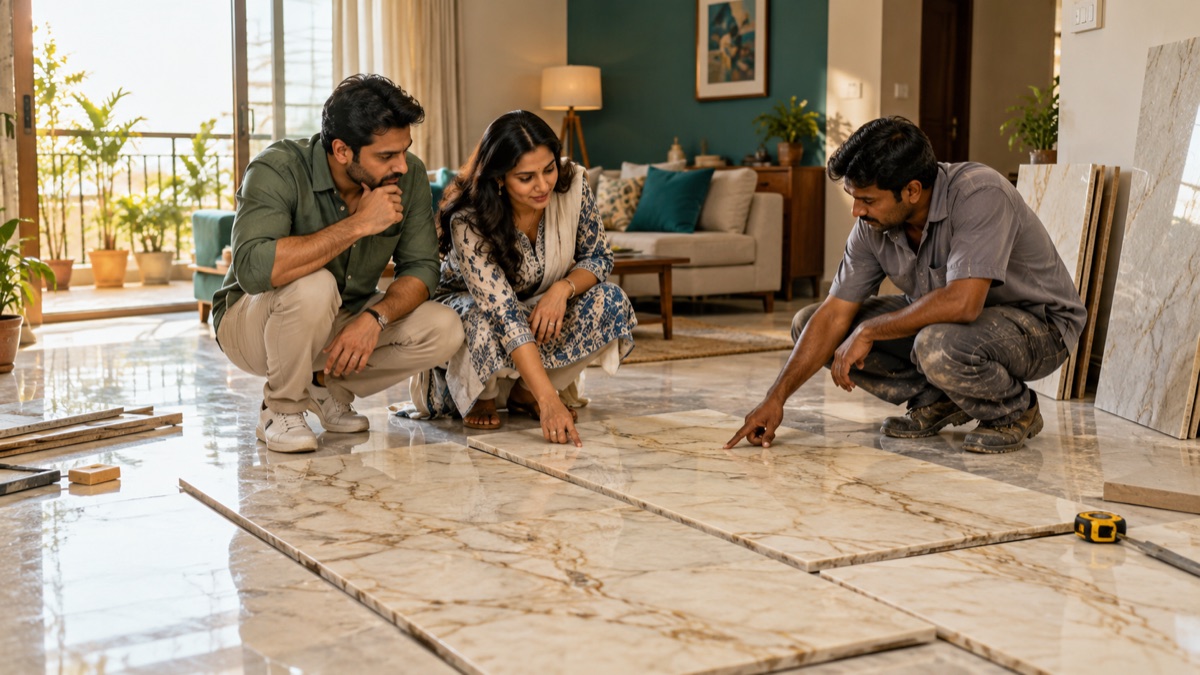
At the stone yard, it is hard to think about labour rates. One slab has a quiet grey vein running across it; another looks almost like moving water. You begin imagining the living room before anyone has discussed how the pieces will be cut, carried upstairs or polished.
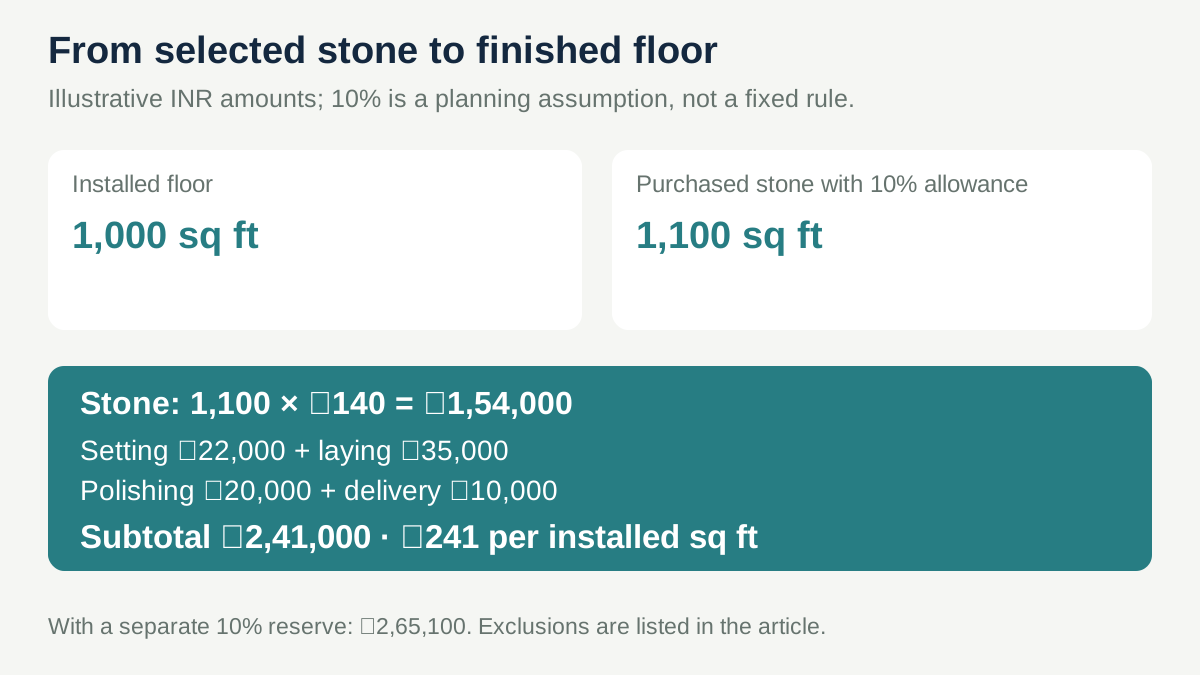
For 1,000 sq ft of actual marble flooring, the worked budget in this guide comes to ₹2,41,000, or ₹241 per installed sq ft, using an assumed stone price of ₹140 per purchased sq ft. A separate 10% planning reserve brings it to ₹2,65,100. All rates are illustrative Indian rupee inputs, not verified market quotations.
The difference between ₹140 and ₹241 is the useful part of the story. You buy more stone than the finished floor area, and the stone needs a suitable base, laying, finishing and handling. A reliable budget gives those stages space on the page before the slabs arrive.
Make sure 1,000 sq ft means the floor being finished
A house described as 1,000 sq ft may include walls, areas receiving another finish or spaces measured under a different area convention. Do not assume its advertised or built-up area equals the marble area.
Measure the rooms and passages that will actually receive marble. Mark bathrooms, utility areas, balconies and other surfaces according to the chosen finish. Record door recesses and any agreed exclusions. If you measure room by room, the same record can later support skirting and finishing estimates without starting again.
In this article, 1,000 sq ft is the net planned floor surface, approximately 92.903 m². Skirting, stair treads, risers, thresholds and wall cladding are separate quantities. They may use the same stone, but they are not automatically included in the floor-area multiplication.
Buy for the cutting layout, not just the area
Marble has a pattern that does not repeat like a printed tile. The way slabs are cut and arranged can change both appearance and usable yield. A vein that looks beautiful on one slab may require careful matching to continue across a room.
For a straightforward estimate, assume 10% extra stone:
1,000 × 1.10 = 1,100 sq ft purchased
At ₹140/sq ft, the stone purchase is 1,100 × ₹140 = ₹1,54,000. The 10% is an example allowance. Actual requirements depend on slab dimensions, defects or unusable portions, pattern selection, cut sizes and the agreed spare stock. A cutting plan can be more informative than another decimal place in the allowance.
Discuss the layout before cutting. Ask which faces will be visible, how pieces will be grouped and whether the chosen finish is suitable for the intended location. RK Marble's installation guidance addresses preparation and installation considerations for natural stone. Use the supplier's instructions for the actual stone and system rather than assuming every marble can be treated identically.
Dry-laying selected pieces for approval can make the proposed appearance easier to understand. An illustration or tiny sample cannot show every variation across a real batch. Agree what is being bought, how it is measured and how any damaged or rejected material is handled.
Build the complete 1,000 sq ft example
The following example assumes a suitable base requiring no major repair and a conventional scope with laying and final polishing quoted separately. If your chosen stone is supplied finished or uses another installation system, revise the scope accordingly.
| Item | Illustrative calculation | Amount |
|---|---|---|
| Marble purchase | 1,100 sq ft × ₹140 | ₹1,54,000 |
| Specified setting materials | 1,000 sq ft × ₹22 | ₹22,000 |
| Laying labour | 1,000 sq ft × ₹35 | ₹35,000 |
| Agreed polishing work | 1,000 sq ft × ₹20 | ₹20,000 |
| Delivery and handling | Allowance | ₹10,000 |
| Installed subtotal | — | ₹2,41,000 |
| Optional reserve | 10% of subtotal | ₹24,100 |
| Planning total with reserve | — | ₹2,65,100 |
The installed subtotal divided by the floor area is ₹2,41,000 ÷ 1,000 = ₹241/sq ft. The reserve is separate from the defined work; it is not an automatic contractor charge.
The example excludes taxes, skirting, stairs, old-floor removal, major base levelling, waterproofing, special treatments or sealers, unusual patterns and extraordinary access costs. A quote may include some of these, but the inclusion should be explicit. If polishing is already part of a supplied-and-installed rate, do not add it a second time.
See what changes when the stone choice changes
Three hypothetical budgets show why the stone selection matters without suggesting a universal market range. Each uses 1,000 sq ft of floor and 1,100 sq ft of purchased stone, but the associated installation assumptions also change.
| Cost component | Example A | Example B | Example C |
|---|---|---|---|
| Stone rate | ₹80/sq ft | ₹140/sq ft | ₹350/sq ft |
| Stone purchase | ₹88,000 | ₹1,54,000 | ₹3,85,000 |
| Setting materials | ₹20,000 | ₹22,000 | ₹35,000 |
| Laying labour | ₹30,000 | ₹35,000 | ₹50,000 |
| Polishing allowance | ₹15,000 | ₹20,000 | ₹35,000 |
| Delivery and handling | ₹8,000 | ₹10,000 | ₹15,000 |
| Subtotal | ₹1,61,000 | ₹2,41,000 | ₹5,20,000 |
| Subtotal per installed sq ft | ₹161 | ₹241 | ₹520 |
These are scenarios, not verified price bands or quality grades. Price alone does not establish a stone's suitability. Obtain the actual slab quotation and the installer's price for the agreed size, pattern, finish and handling conditions.
An expensive slab also makes avoidable cutting mistakes more expensive. Discuss the cutting plan, storage and protection with the installer before deciding that a low laying rate is the best place to save.
A smaller floor does not always have the same installed rate
Suppose only 500 sq ft is being finished using the middle example's variable rates. With 10% extra stone, the purchase becomes 550 sq ft:
| Item | Amount |
|---|---|
| Stone: 550 × ₹140 | ₹77,000 |
| Setting materials: 500 × ₹22 | ₹11,000 |
| Laying: 500 × ₹35 | ₹17,500 |
| Polishing: 500 × ₹20 | ₹10,000 |
| Example delivery and handling | ₹7,000 |
| Subtotal | ₹1,22,500 |
The result is ₹245 per installed sq ft, slightly above ₹241 in the larger example, because the handling allowance does not halve. Minimum mobilisation charges or difficult access can have a similar effect. This is why multiplying a neighbour's per-square-foot total by your floor area can produce a misleadingly precise answer.
What sits underneath the marble?
Before buying setting materials, establish the specified installation method, base condition and finished level. Stone thickness, substrate, moisture, compatibility and the supplier's instructions matter. A generic cement-and-sand calculation is not a substitute for deciding which system suits the stone.
To demonstrate quantity arithmetic only, suppose a specified bedding layer is 20 mm thick over 92.903 m²:
Wet bedding volume = 92.903 × 0.020 = 1.8581 m³
With an assumed dry-volume factor of 1.33, that becomes 2.4712 m³. If the specified mix is 1:4 cement to sand by volume, the estimate uses one fifth for cement and four fifths for sand. Assuming cement bulk density 1,440 kg/m³, 50 kg bags and a 5% material allowance, the result is about 14.95 bags, rounded up to 15 bags, and 2.08 m³ of sand.
Those assumptions are not a recommendation to install every marble floor on a 20 mm, 1:4 bed. A selected adhesive or another specified system has its own consumption and application requirements. Nor should these quantities be added to the earlier ₹22,000 setting-material allowance unless that allowance is being replaced by a detailed quantity-based price; otherwise the same work is counted twice.
Polishing, protection and the day you move in
“Polish included” deserves a more detailed sentence. Confirm the required finish, operations, edges and any special treatment. Ask what protection is needed while other trades continue working. A finished floor can be damaged by later construction activity, and repair responsibility is easier to agree before the rooms fill with ladders and tools.
Check transitions to other finishes, door clearances and skirting details while levels can still be adjusted within the approved installation plan. At handover, ask the supplier for the appropriate cleaning and maintenance instructions for the stone and finish. Avoid assuming that any general-purpose bathroom cleaner is suitable for natural stone.
Turn the stone-yard choice into a comparable quote
Keep four records together: the measured floor areas, the selected slabs or product details, the proposed cutting layout and the complete installation scope. Ask each quotation to state purchase area, measurement method, delivery, laying, polishing, exclusions and tax treatment.
The tile and floor measurement calculator can help organise rectangular floor measurements, but irregular slab yield and vein matching still need a cutting plan; tile-box assumptions should not be applied to marble slabs. For an alternative finish, the tile installation cost guide shows the same complete-budget approach. This marble guide is also available in Hindi.
The floor will be something you see every day. Giving the estimate the same attention as the slab selection helps the finished room resemble the one you imagined at the stone yard—and gives you a clear account of what it took to get there.