100 Feet Boundary Wall Cost: Bricks, Mortar, Plaster and Scope
Work through a 100 ft boundary wall example with 5,018 bricks, mortar, two-sided plaster and clearly separated foundation and pillar allowances.
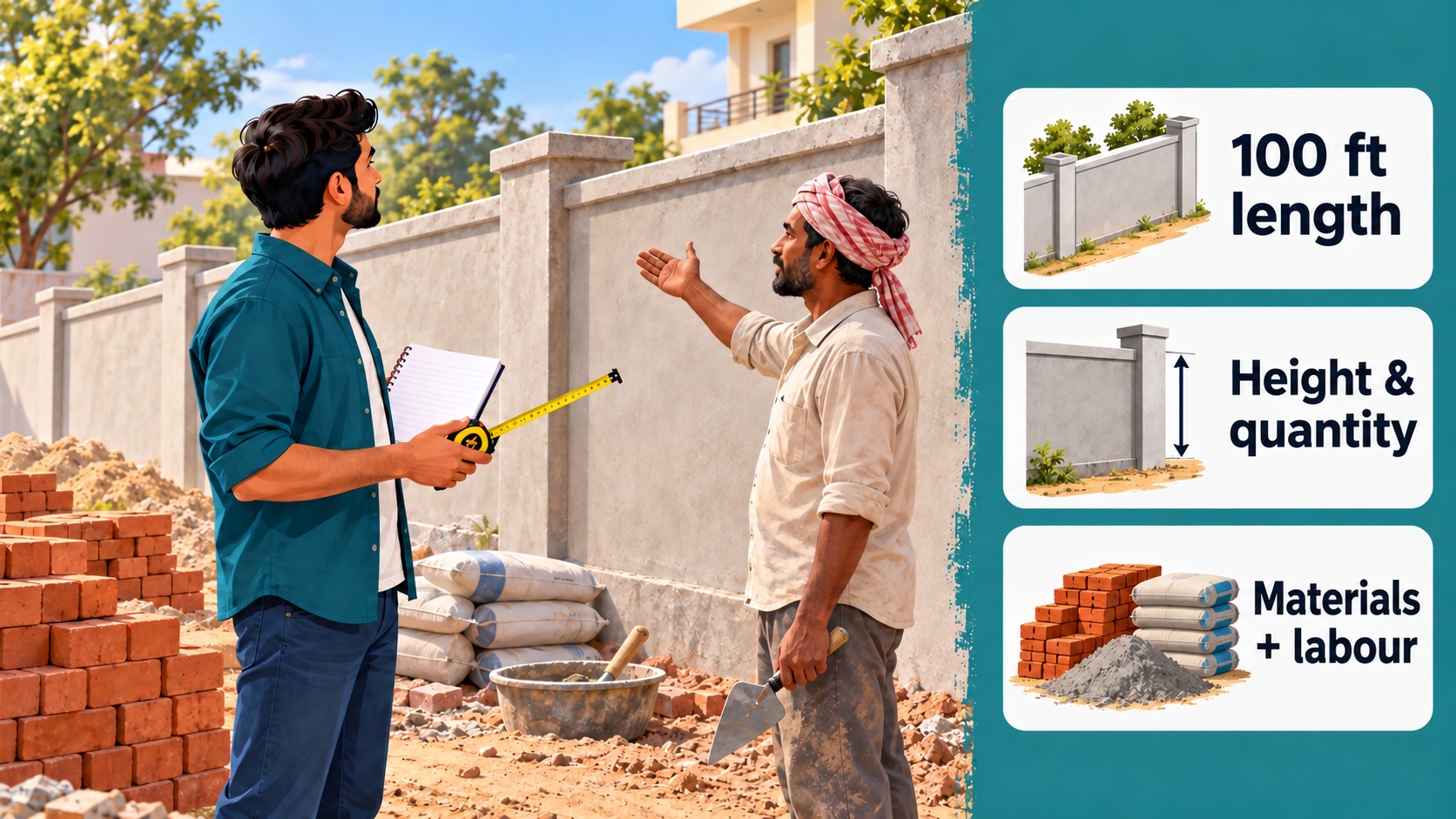
construction materials
In this guide6 sections
Two quotations both say “100 feet of boundary wall,” but one includes the foundations and plaster while the other covers bricklaying alone. Their totals cannot be compared until the work is described in the same way.
This worked example has 100 ft overall length, 5 ft above-ground height and 9 in brick thickness. Deducting the pillar positions leaves 90 ft of brick infill. The calculated purchase is 5,018 bricks, with separate mortar and plaster quantities. The complete illustrative cost table totals ₹1,50,700, or ₹1,65,770 with a separate 10% reserve. These are authored examples, not surveyed local rates or a structural design.
Describe the wall before asking for its price
Record the overall length, height above ground, specified thickness, gate opening, pillar positions and plaster faces. Foundations and reinforced concrete need their own approved dimensions and specification. The example dimensions here must not be used to choose a foundation or pillar arrangement for your site.
The starting layout has 100 ft overall length. In this arithmetic example, pillar positions take up a combined 10 ft, leaving 90 ft of brickwork. The deduction is a measured allowance, not a recommendation for pillar width or spacing. An actual gate or opening needs its own deduction.
Convert the brick infill to volume
The net masonry volume is 90 × 5 × 0.75 = 337.5 ft³, approximately 9.55694 m³. Use the same units throughout. Nine inches is 0.75 ft or 228.6 mm; it is not 9 ft.
In the linked calculator, the overall wall is entered as 100 ft, then 50 ft² is deducted for the pillar positions. This gives the same 450 ft² of net brick face. Keep pillar concrete outside the masonry quantity.
Count bricks using the actual size and joint
The example brick is 190 × 90 × 90 mm. Including a 10 mm mortar joint gives a nominal module of 200 × 100 × 100 mm, or 0.002 m³ per brick and joint.
9.55694 ÷ 0.002 ≈ 4,778.47 bricks
With the illustrative 5% cutting and breakage allowance, 4,778.47 × 1.05 ≈ 5,017.39, rounded up to 5,018 whole bricks. Confirm the supplied brick dimensions and the specified joint before ordering. A different brick size changes the result even if the wall measurement stays the same.
Keep masonry mortar and surface plaster separate
For the mortar example, use the specified 1 cement : 6 sand, a 1.33 dry-volume factor, cement density of 1,440 kg/m³ and 50 kg bags. These describe the arithmetic only; use the actual project specification for your work.
After subtracting brick volume, the wet mortar is approximately 2.203 m³. The dry quantity is approximately 2.930 m³, giving about 12.05 bags of cement before allowance. Including 5% and buying whole bags gives 13 bags, with about 2.64 m³ of sand.
Both plaster faces include the pillar fronts, so their measured area is 100 × 5 × 2 = 1,000 ft². The example uses 12 mm plaster, 1:4 cement-to-sand, the same dry factor and 5% allowance. This gives approximately 9 cement bags and 1.25 m³ of sand. Top strips, returns and other exposed surfaces need separate measurements.
| Listed above-ground work | Cement purchase | Sand, approximately |
|---|---|---|
| Masonry mortar | 13 bags | 2.64 m³ |
| Two-sided plaster | 9 bags | 1.25 m³ |
| Total | 22 bags | 3.89 m³ |
Put the complete example on one cost sheet
The table deliberately separates measured above-ground work from an allowance for excavation, foundations and concrete. Its rates are illustrative. Obtain quantities and quotes for the approved design before replacing that allowance.
| Work or purchase | Illustrative calculation | Amount |
|---|---|---|
| Bricks | 5,018 × ₹9 | ₹45,162 |
| Masonry cement | 13 × ₹420 | ₹5,460 |
| Masonry sand | 2.64 m³ × ₹1,800 | ₹4,752 |
| Plaster cement | 9 × ₹420 | ₹3,780 |
| Plaster sand | 1.25 m³ × ₹1,800 | ₹2,250 |
| Other plaster materials | Allowance | ₹2,000 |
| Masonry labour | Rounded 9.56 m³ × ₹1,600 | ₹15,296 |
| Plaster labour | 1,000 ft² × ₹14 | ₹14,000 |
| Excavation, foundations, pillars and top concrete | Separate material and labour allowance | ₹50,000 |
| Delivery and unloading | Allowance | ₹8,000 |
| Listed subtotal | ₹1,50,700 | |
| Separate 10% reserve | ₹15,070 | |
| Planning total | ₹1,65,770 |
The subtotal is ₹1,507 per overall foot. That is a complete listed-scope equivalent, not the bricklaying labour rate. Gates, painting, permission-related costs and applicable taxes still need checking. The calculator card below transfers the measured masonry and plaster scope; it excludes the foundation, concrete and fixed allowances in this table.
Compare the work behind the total
When a quotation is cheaper, return to the drawing and ask which height, thickness, foundations, pillars, gate opening and plaster faces it covers. Increasing height from 5 ft to 6 ft adds 20% to the same-length brick face; the complete bill does not necessarily rise by exactly 20%. The approved supporting work must be reviewed too.
Give each contractor the same dated drawing, brick dimensions and finish schedule. Write down responsibility for supply, unloading, breakage and exclusions. Keep boundary work separate in the whole-house estimate so it is counted once. Reuse the measurements when prices change, while keeping the original scope visible.