Rebar Weight Formula and Chart: D²/162, kg/m and kg/ft
Turn a bar schedule into kilograms with the D²/162 formula, a rebar weight chart, metre-to-foot examples and a clear purchase calculation.

construction materials
At a glance
In this guide7 sections
The delivery slip says kilograms. The drawing says millimetres and metres. On the ground, the steel is simply a bundle of long, ribbed bars. Before you can check whether the bill makes sense, those three descriptions have to meet.
For a quick estimate, rebar weight in kilograms per metre is D² ÷ 162, where D is the nominal bar diameter in millimetres. Multiply that unit weight by the total length in metres to get kilograms. If your lengths are in feet, multiply the kg/m value by 0.3048 first.
A 12 mm bar, for example, weighs approximately 0.889 kg/m, or 0.271 kg/ft. A 12-metre length therefore weighs about 10.67 kg. That is enough to begin checking a quantity sheet. It is not enough to decide which bars belong in a slab, column or beam; the engineer's drawings and bar bending schedule supply that information.
The formula, without the mystery
A thicker bar contains more steel along every metre. The important detail is that thickness does not affect weight in a straight line. Double the diameter and the circular cross-sectional area becomes four times as large. That is why the formula squares D.
For a circular steel section, the underlying calculation is:
Weight per metre = π ÷ 4 × (diameter in metres)² × steel density
Using an assumed steel density of 7,850 kg/m³ and expressing diameter in millimetres gives approximately 0.006165 × D² kg/m. The familiar D²/162 is a convenient approximation to that relationship. For ribbed reinforcement, use the bar's nominal diameter, not a measurement taken across the outer tips of its ribs.
The denominator belongs to this particular combination of units. Entering 0.012 for a 12 mm bar while still dividing by 162 would give a very small, very wrong answer. Write “D in mm” beside the formula if you are making your own spreadsheet.
Manufacturer tables may differ slightly from a rounded formula chart. For example, SAIL's rebar brochure publishes nominal masses and applicable tolerances. Use the supplier's current product specification and the agreed weighing arrangements when accepting a delivery; this guide's calculation is an estimate, not a certification of a particular batch.
Rebar weight chart: common metric diameters
The values below are calculated using D²/162. They are not a copied manufacturer acceptance table. Unit weights are rounded to three decimals; the 12-metre weights are rounded to two. Keep more digits in your calculation and round the final total, especially on a large order.
| Nominal diameter | Weight, kg/m | Weight, kg/ft | One 12 m bar, kg |
|---|---|---|---|
| 6 mm | 0.222 | 0.068 | 2.67 |
| 8 mm | 0.395 | 0.120 | 4.74 |
| 10 mm | 0.617 | 0.188 | 7.41 |
| 12 mm | 0.889 | 0.271 | 10.67 |
| 16 mm | 1.580 | 0.482 | 18.96 |
| 20 mm | 2.469 | 0.753 | 29.63 |
| 25 mm | 3.858 | 1.176 | 46.30 |
| 32 mm | 6.321 | 1.927 | 75.85 |
| 40 mm | 9.877 | 3.010 | 118.52 |
Availability of these diameters and stock lengths varies by manufacturer and market. The 12 m column is a reference length, not a promise that every supplier sells every size that way. In markets using numbered bars or another designation system, obtain the actual nominal diameter or the manufacturer's mass-per-length figure; a bar number is not automatically a diameter in millimetres.
The chart is also a useful sense check. A 16 mm bar should weigh roughly four times as much per metre as an 8 mm bar. If a sheet shows only twice the weight, someone has probably treated diameter as a linear multiplier.
Metres and feet: the small difference that travels through the bill
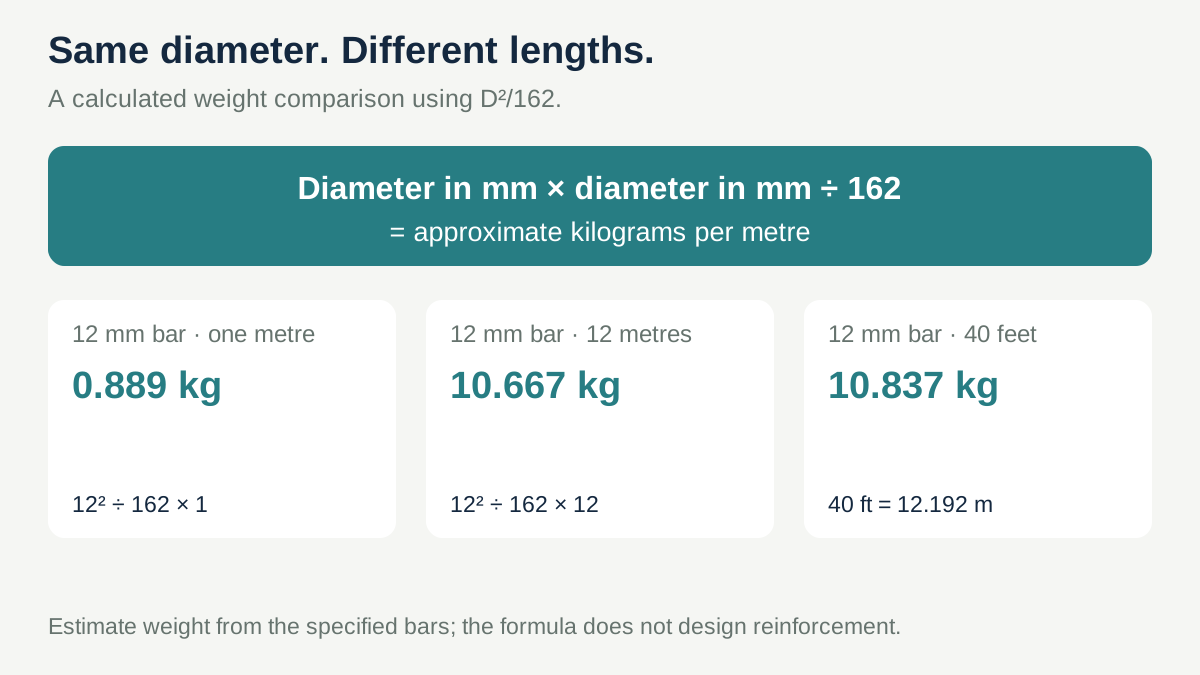
Imagine two quotes lying beside one another. One lists 12 m bars. The other lists 40 ft bars. In conversation, both may get called “forty-foot lengths,” but their calculated weights are different.
One international foot is exactly 0.3048 m, as set out in NIST's unit conversion factors. Therefore:
- 12 m = approximately 39.3701 ft.
- 40 ft = 12.192 m.
- A 12 mm × 12 m bar weighs 12² ÷ 162 × 12 = 10.6667 kg.
- A 12 mm × 40 ft bar weighs 12² ÷ 162 × 40 × 0.3048 = 10.8373 kg.
The difference is around 0.17 kg per bar in this example. On one bar it is easy to overlook. Across a delivery it can explain a discrepancy that otherwise looks like an arithmetic mistake. Confirm the actual ordered length instead of silently treating the two lengths as identical.
A worked schedule: two diameters, one total
Suppose an approved cutting schedule contains these two lines. We are using the listed cut lengths as supplied; we are not adding or designing hooks, bends, laps or anchorage.
| Schedule line | Diameter | Length each | Quantity | Total length | Calculated weight |
|---|---|---|---|---|---|
| A | 12 mm | 12 m | 20 | 240 m | 213.33 kg |
| B | 16 mm | 8 m | 10 | 80 m | 126.42 kg |
| Total | — | — | 30 pieces | — | 339.75 kg |
Line A is 12² ÷ 162 × 12 × 20 = 213.3333 kg. Line B is 16² ÷ 162 × 8 × 10 = 126.4198 kg. Add the unrounded results, then round: 339.7531 kg, or 339.75 kg.
Notice that the pieces in line B are 8 m long. If the supplier sells that diameter only in 12 m lengths, the cutting plan matters. Ten 8 m pieces do not become ten fully usable 12 m bars without leaving offcuts. Some offcuts may serve other approved schedule lines; some may not. A blanket percentage cannot tell you which.
Tata Steel's ready-to-use reinforcement documentation explains the role of bar bending schedules in translating structural drawings into reinforcement quantities and shapes. For a homeowner, the practical request is simple: ask for the schedule that the quantity estimate came from, and keep its revision with the estimate.
Theoretical weight, purchase weight and the invoice
These are three related numbers, but they answer different questions. Theoretical weight describes the scheduled steel. Purchase weight describes what you plan to order after the cutting plan, usable stock and purchasing increments are considered. The invoice records what was supplied and how the supplier agreed to charge.
To illustrate the arithmetic only, suppose the 339.7531 kg schedule is given a 3% purchasing allowance and the order is rounded upward in 10 kg increments:
339.7531 × 1.03 = 349.9457 kg → 350 kg ordered
At an assumed example rate of ₹65/kg, the material allowance becomes 350 × ₹65 = ₹22,750. This is not a verified current steel price, and 3% is not a recommended universal allowance. Replace both with your quotation and cutting-plan assumptions. Transport, unloading, cutting, bending, tying labour, binding wire and taxes need their own scope lines unless the quote explicitly includes them.
Do not add an allowance for laps if those same laps are already included in the scheduled cut lengths. Equally, do not remove required reinforcement because a spreadsheet appears to have “extra” weight. Quantity reconciliation belongs alongside the approved drawing, not in place of it.
Use the calculator with the information you actually have
The rebar quantity calculator can turn known bar dimensions and quantities into weight. Choose the input method that matches your information: counted bars, a specified spacing arrangement, or a schedule. A spacing input calculates a quantity from your supplied arrangement; it does not establish whether that arrangement is structurally suitable.
Check the unit shown beside every length field. Where a field asks for feet, a 12 m stock length is approximately 39.3701 ft, not 12. Keep allowance and purchasing rounding visible so another person can reproduce the total. For a mixed schedule, calculate the different diameters separately before adding their weights.
If all you know is that the house or roof covers 1,000 sq ft, you do not yet have a reinforcement schedule. Our guide to steel quantities for a 1,000 sq ft roof explains why floor area alone cannot determine the required steel.
Questions that usually appear at delivery time
How much does one 12 mm bar weigh?
About 0.889 kg for each metre of length using D²/162. At 12 m, that is about 10.67 kg. Always include the length when asking for the weight of “one bar.”
Can I turn kilograms back into metres?
Yes. Divide weight by the unit weight for that diameter. For example, 100 kg ÷ (12²/162) = 112.5 m of theoretical 12 mm bar length. This does not tell you how many usable cut pieces you can obtain; that still depends on their required lengths and the stock available.
Why does the scale disagree with the formula?
First check diameter, piece count, actual length, unit conversion and rounding. Then check the product's specified nominal mass and tolerances, and the weighing basis agreed with the supplier. The formula gives you a clear starting point for that conversation. The useful document to take to the yard is a short schedule with those inputs written down, rather than a total whose origin nobody can explain.